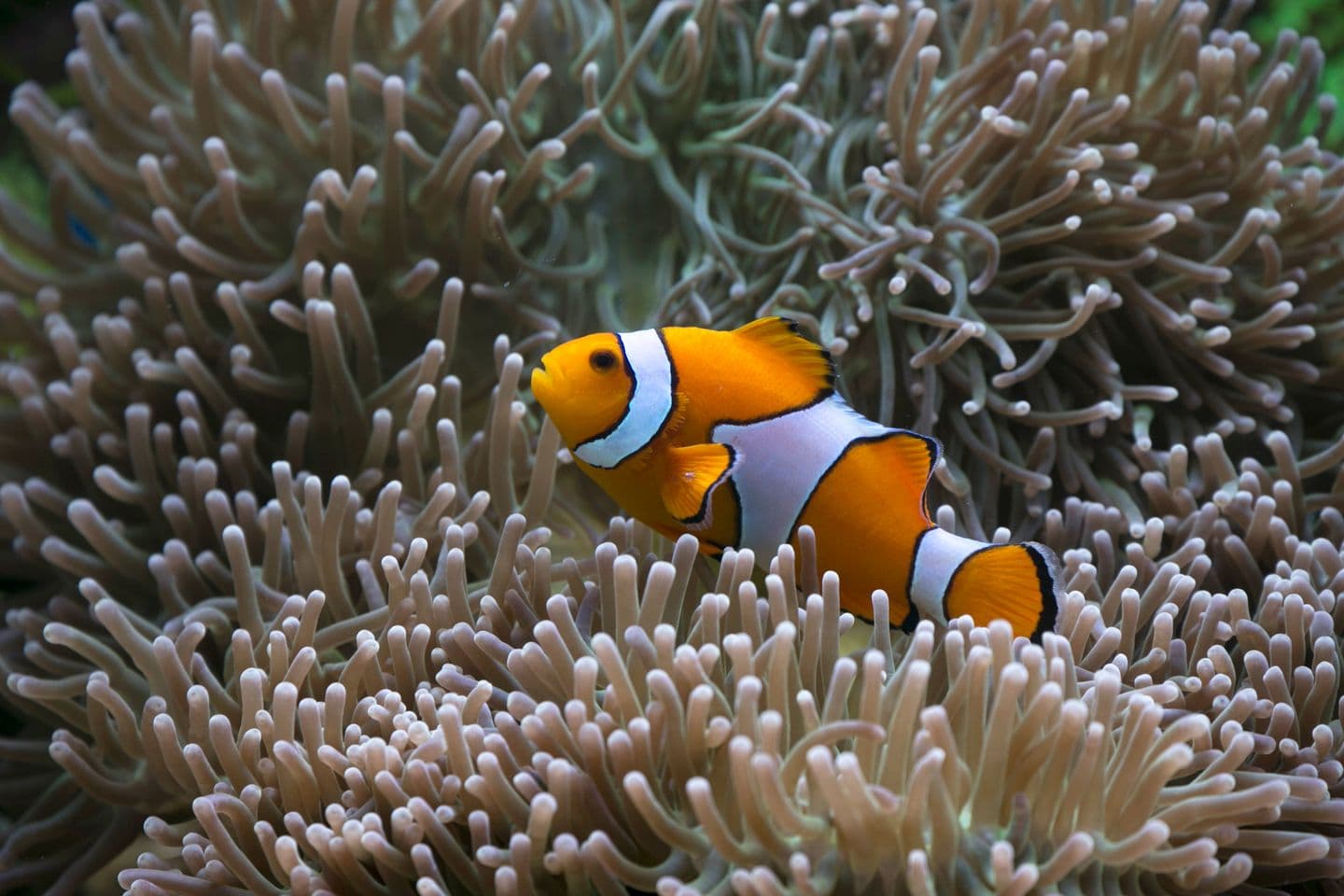
Clownfish, or anemonefish, are the fish most Indian aquarists cut their teeth on when they move from freshwater to marine. They belong to the damselfish family, Pomacentridae, but unlike their pugnaci
Clownfish, or anemonefish, are the fish most Indian aquarists cut their teeth on when they move from freshwater to marine. They belong to the damselfish family, Pomacentridae, but unlike their pugnacious cousins covered later in this document, most clownfish are manageable, colourful and genuinely interesting to watch. Every clownfish is born male and can change into a female if the dominant female in its group is lost, so a settled pair is really a male and a female working out that arrangement between them. Hosting an anemone is a bonus, not a requirement. Tank raised clownfish, which now make up the bulk of what is sold in India, often never bother with an anemone at all and do perfectly well treating a rock crevice or a coral head as home. Below are the ten clownfish most likely to turn up in an Indian marine fish shop, grouped by how closely related they are.
Ocellaris Clownfish (Amphiprion ocellaris)
Also called the Common Clown or False Percula, this is the fish most people picture when they hear the word clownfish, and the one that inspired Finding Nemo. It is bright orange with three white bands outlined in thin black, though wild populations from different reefs can run darker or almost black. Ocellaris is the most forgiving marine fish for a first saltwater tank in India: it tolerates the inevitable small parameter swings of a new setup better than almost anything else on a reef stocklist, eats any food offered to it without fuss, and settles into a routine quickly. It is also the one clownfish on this list that is genuinely native to Indian waters, with wild populations recorded around the Andaman and Nicobar Islands in the eastern Indian Ocean, alongside its wider range through Southeast Asia and northern Australia.
Size: grows to 7 to 9 cm, females larger than males
Temperament: peaceful; avoid keeping two unrelated pairs in the same tank
Minimum tank size: 75 to 110 litres for a pair
Diet: omnivore, accepts pellets, flakes and frozen mysis or brine shrimp
Difficulty: easy, suitable for a first marine fish
Almost all Ocellaris sold in India today are captive bred, either imported from Southeast Asian hatcheries or bred domestically. ICAR's Central Marine Fisheries Research Institute has run a working captive breeding programme for this species at its Vizhinjam Research Centre in Kerala for some years now, alongside several other clownfish covered in this document, as part of a wider push to reduce the trade's reliance on wild-caught stock. Captive bred fish of any origin adapt to Indian tap water and RO-mixed saltwater far more readily than wild caught fish, and are worth paying slightly more for.
Black Ocellaris Clownfish
This is not a separate species but a colour form of Amphiprion ocellaris in which the orange is replaced almost entirely by black, leaving the same three white bands. It occurs naturally around parts of northern Australia, where it is sometimes called the Darwin clown, and has been selectively bred in captivity to fix the dark colouration. Every care requirement is identical to the standard Ocellaris; the only difference is cosmetic.
Size, tank size, diet and temperament: same as standard Ocellaris
India note: sold at a premium over standard orange Ocellaris, usually as captive bred stock only; this colour morph has itself been successfully captive bred at CMFRI's Vizhinjam Research Centre in Kerala
Snowflake Clownfish
Snowflake is a designer Ocellaris morph in which the white banding spreads out into broad, irregular, frost-like patches rather than staying as three neat vertical bars. No two Snowflakes look exactly alike, and breeders grade them by how much white coverage a fish shows, with heavily patterned Premium or Ultra grades commanding a higher price. Because the widened white patches can occasionally affect swimming coordination in the most extreme examples, Snowflakes are considered slightly more dependent on their host anemone or a secure rock territory than a plain Ocellaris, though this is a minor consideration for most specimens.
Size, diet, temperament: same as standard Ocellaris
Difficulty: easy, though extreme-pattern individuals can be slightly less robust swimmers
India note: a specialist order item in most cities, priced well above plain Ocellaris
Picasso Clownfish
Picasso is a designer colour morph, but of the True Percula rather than the Ocellaris, which causes regular confusion in shops since Snowflake and Picasso are often displayed side by side. Picasso patterning shows as bold, connected white patches that look almost jigsaw-like against the orange body, and graders rank specimens from Standard through Premium to Extreme depending on how much the white spreads and connects across the back. Care is identical to a standard Percula clownfish, described below.
Size, diet, temperament: same as True Percula clownfish
India note: a high-value designer fish, generally special-ordered rather than stocked as a walk-in item
Percula Clownfish (Amphiprion percula)
Often called the True Percula to distinguish it from the near-identical Ocellaris, Amphiprion percula has a slightly deeper orange body, thicker black outlining on its white bands, and ten dorsal spines against the Ocellaris' eleven, a detail only useful if you have a very patient fish and a magnifying glass. In practice, Percula tends to be a touch feistier and slightly pricier than Ocellaris. Sources disagree on which of the two grows larger, with figures ranging narrowly either way depending on the population, so it is safest to treat their adult size as broadly comparable rather than expect a clear difference. Unlike Ocellaris, Percula is not found in Indian waters; its natural range runs through northern Australia, Papua New Guinea and the western Pacific, so every Percula in the Indian trade is either imported or captive bred, and CMFRI's Vizhinjam centre has bred this species too.
Size: up to 8 to 10 cm
Temperament: peaceful to mildly territorial, a shade bolder than Ocellaris
Minimum tank size: 75 to 110 litres for a pair
Diet: omnivore, same as Ocellaris
Difficulty: easy
Clarkii Clownfish (Amphiprion clarkii)
Clarkii is the generalist of the clownfish world. It is the species most willing to host almost any anemone offered to it, from bubble tip to carpet anemones, which made it a favourite with hobbyists trying to keep an anemone paired with a clown. It is also noticeably hardier and more adaptable to imperfect water conditions than Ocellaris or Percula, which suits it well to the variable tap and borewell water many Indian aquarists start out with, though a proper RO unit is still strongly recommended for any marine tank. The trade-off is temperament: Clarkii is semi-aggressive and becomes territorial as it matures, particularly toward other clownfish species.
Size: up to 12 to 15 cm, one of the larger common clowns
Temperament: semi-aggressive, more so with age
Minimum tank size: 110 to 150 litres
Diet: omnivore, hardy eater
Difficulty: easy to moderate, forgiving of water quality lapses but needs room as it grows
Tomato Clownfish (Amphiprion frenatus)
Tomato clowns are a deep red-orange with a single white bar behind the eye in adults, though juveniles often show a second faint bar that fades as they mature. They are hardy, easy to feed and readily available, but they are also possessive of their territory, especially once paired, and are not a good match for smaller or more timid tankmates in a modest aquarium. A single Tomato clown or an established pair does well in a moderately sized fish-only or lightly stocked reef tank.
Size: up to 12 to 14 cm, females noticeably larger than males
Temperament: semi-aggressive, territorial once settled
Minimum tank size: 110 litres
Diet: omnivore, unfussy
Difficulty: easy, but plan tankmates carefully
Cinnamon Clownfish (Amphiprion melanopus)
Also sold as the Red and Black Anemonefish, the Cinnamon clown starts life a fairly uniform reddish orange with a single white head bar and darkens with age, with the body fading toward a deep mahogany or near-black while the face and fins keep a warmer cinnamon tone. It is one of the larger and more assertive clownfish on this list, and while it can be kept in a well aquascaped community tank, it will not tolerate other clownfish sharing its space and can bully smaller, meeker fish if the tank is sparsely decorated.
Size: up to 12 to 15 cm
Temperament: semi-aggressive to aggressive, worse in bare tanks
Minimum tank size: 150 litres, more with tankmates
Diet: omnivore, hardy
Difficulty: easy for an experienced keeper, less ideal as a true first fish
Maroon Clownfish (Premnas biaculeatus)
Maroon clownfish sit in their own genus, separate from the Amphiprion clowns above, and it shows in both looks and attitude. They are a deep burgundy red with three vertical bands, carry a small spine below each eye that no other clownfish has, and are, without much debate, the most aggressive and territorial clownfish kept in the hobby. A dominant female Maroon will happily take over an entire modestly sized aquarium and harass anything that crosses into what she considers her patch, including fish several times her size. They are not a beginner's fish and are best kept either singly or as an established, deliberately paired male and female in a large tank with plenty of rockwork to break sightlines.
Size: up to 15 to 17 cm, one of the largest clownfish species
Temperament: aggressive and highly territorial, more so as adults
Minimum tank size: 150 litres for a juvenile, 250 litres or more for a mature pair
Diet: omnivore, robust appetite
Difficulty: moderate; the challenge is behaviour management, not water chemistry
India note: CMFRI's Vizhinjam Research Centre in Kerala has an established captive breeding programme for this species, so domestically bred juveniles do turn up alongside imports
Gold Stripe Maroon Clownfish
This is a geographic colour variant of the Maroon clownfish, originating from populations around Sumatra, in which the usual white banding is replaced by a rich gold or yellow. It is prized in the trade for that colouration and often priced above the standard white-striped Maroon, but its size, temperament, tank requirements and general care are identical to the species profile above. Anyone considering a Gold Stripe Maroon should plan for the same large, well-aquascaped, single-clownfish setup that any Maroon needs.
Size, temperament, tank size, diet: same as standard Maroon Clownfish
India note: a sought-after specialist item, generally costlier than the standard colour form
The scissortail rasbora, Rasbora trilineata, gets its name from the black-and-white banded tail fin, which opens and closes in a scissoring motion as the fish swims, a genuinely visible behaviour rath
Flushing a fish, whether dead or simply unwanted, down the toilet is a habit many Indian households have inherited without questioning it, and it carries real risks that are worth understanding.
A cover might seem like an afterthought compared to filtration or lighting, but for a saltwater tank it does real, unglamorous work: cutting evaporation, which matters a great deal given how salinity