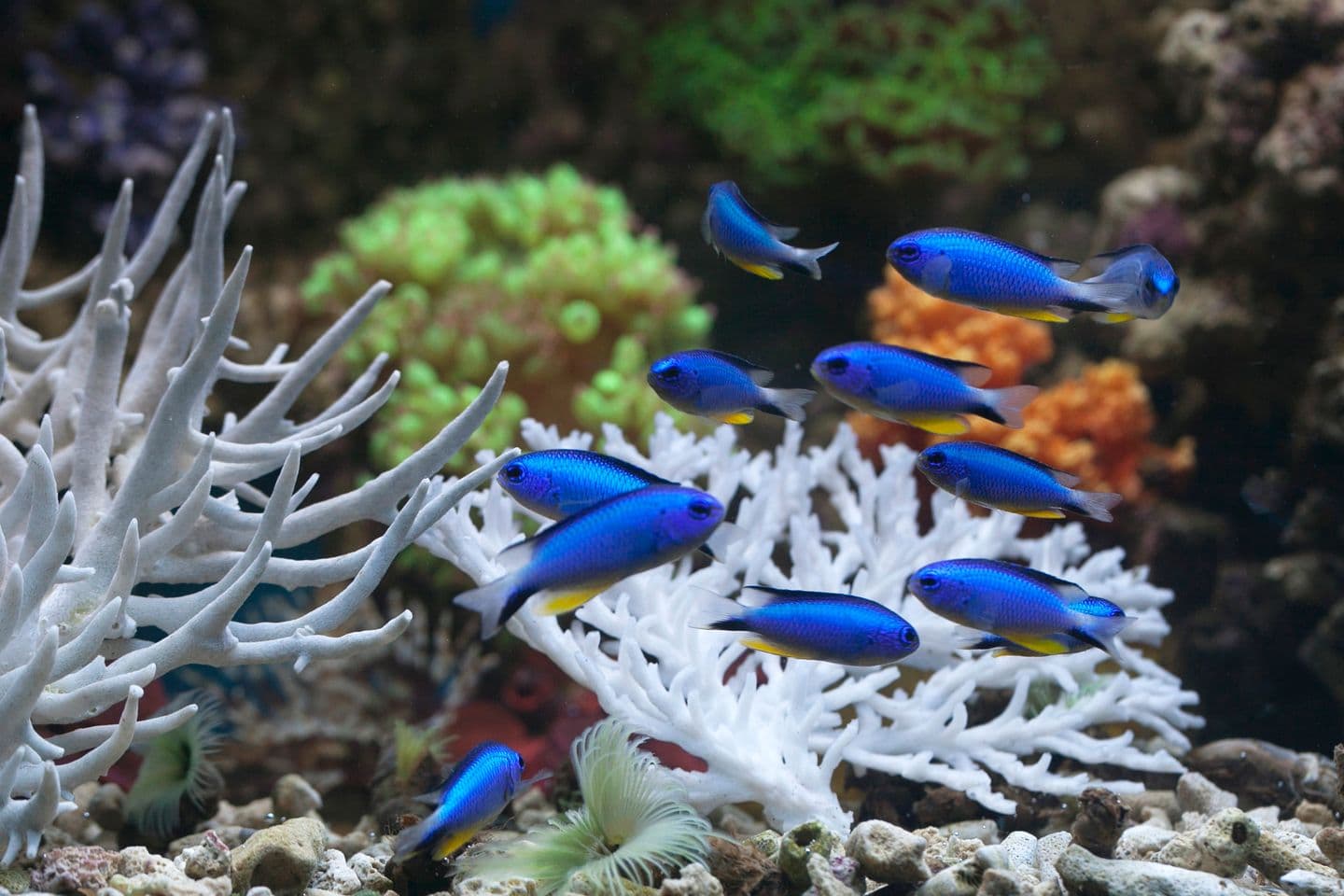
Damselfish belong to the same family as clownfish, Pomacentridae, and share the same small, hardy, brightly coloured build, but without the more forgiving temperament. Nearly every damsel on this list
Damselfish belong to the same family as clownfish, Pomacentridae, and share the same small, hardy, brightly coloured build, but without the more forgiving temperament. Nearly every damsel on this list is territorial to some degree, and several are genuinely feisty for their size, quite prepared to chase, nip and even bump a hand that enters their claimed patch of rock. This reputation has made damsels the classic starter fish for cycling a new saltwater tank in India for decades, a practice most marine keepers today discourage on welfare grounds, since it exposes the fish to a spike in ammonia and nitrite it was never meant to sit through. A far kinder route to cycle a tank is with quality live rock or a bottled bacterial culture, with damsels added afterward, if at all. Damsels do best when introduced last into an established tank and given plenty of separate rock structures so that each fish can claim its own corner without constant conflict.
Blue Damselfish (Chrysiptera cyanea)
Known widely as the Blue Devil, this is a small, brilliant electric blue fish, with males often carrying an orange-tinged tail. Its nickname is well earned: Blue Devils are among the most aggressive fish for their size kept in the marine hobby, chasing tankmates far larger than themselves and readily nipping at a hand doing maintenance in the tank. They are extremely hardy and tolerate the water quality swings of an immature tank far better than most fish, which is exactly why they were historically used to cycle new setups, though this is not a practice worth repeating today.
Size: up to 7 to 8 cm
Temperament: highly aggressive, especially toward new arrivals and other blue damsels
Minimum tank size: 110 litres
Diet: omnivore, unfussy, accepts flake, pellet and frozen foods
Difficulty: very easy, the challenge is behaviour, not husbandry
India note: CMFRI has bred this species in captivity at its Vizhinjam Research Centre in Kerala, so captive bred stock does circulate alongside wild caught imports
Yellowtail Blue Damselfish (Chrysiptera parasema)
A sapphire blue body with a contrasting bright yellow tail makes this one of the most photogenic small damsels, and it is also, by general agreement among marine keepers, one of the calmest true damsels available. It is still territorial and will defend a chosen rock, but it is far less prone to the relentless harassment that Blue Devils or Three Stripe damsels dish out, which makes it a reasonable choice for a community reef tank if introduced with care. Keeping a small group of three or more can spread out any territorial behaviour rather than concentrating it on one tankmate.
Size: up to 6 to 7 cm
Temperament: mild for a damselfish, moderately territorial
Minimum tank size: 75 to 110 litres for one fish, larger for a small group
Diet: omnivore, takes zooplankton-based frozen foods well
Difficulty: easy, a reasonable first damsel for a reef tank
Domino Damselfish (Dascyllus trimaculatus)
Also called the Three Spot Damsel, this species is a deep black or dark brown with three distinct white spots, one on the forehead and one on each side. Juveniles are known to shelter within the tentacles of large anemones, much like baby clownfish, but they lose this habit and grow considerably larger and considerably more territorial as adults. A full grown Domino needs a proportionately larger tank than its juvenile size suggests, and it is not a fish to mix casually with smaller, peaceful tankmates.
Size: up to 13 to 14 cm, one of the largest common damsels
Temperament: aggressive, worsens with age and size
Minimum tank size: 200 litres or more for an adult
Diet: omnivore, hardy eater
Difficulty: easy to keep alive, harder to house peacefully long term
Three Stripe Damselfish (Dascyllus aruanus)
Sometimes called the Humbug Damsel for its bold black and white vertical stripes, this species is extremely hardy and inexpensive, which has made it a fixture in Indian marine fish shops for years. Young Three Stripe damsels are usually sold and kept in small groups, where they look striking darting in and out of branching rock or coral, but a hierarchy tends to emerge as they mature, with the dominant fish becoming increasingly territorial and sometimes harassing the rest of the group. Plenty of rockwork with multiple hiding spots is essential if keeping more than one.
Size: up to 8 to 9 cm
Temperament: hardy and increasingly territorial with age
Minimum tank size: 110 litres
Diet: omnivore, easy to feed
Difficulty: easy, a common and affordable entry-level damsel in India
Azure Damselfish (Chrysiptera hemicyanea)
Azure damsels are often mistaken for Yellowtail Blue damsels because both are blue bodied with yellow accents, but the Azure carries yellow across its belly and lower body rather than restricting it to the tail. It grows to a similar size and shares a similar, relatively mild temperament for a damselfish, adapting well to both small nano reef setups and larger community tanks. It is a solid, easy-care option for anyone who wants damselfish colour without the worst of the family's usual belligerence.
Size: up to 6 to 7 cm
Temperament: relatively peaceful for a damsel, still territorial over its chosen rock
Minimum tank size: 75 to 110 litres
Diet: omnivore, unfussy
Difficulty: easy
India note: also part of CMFRI's Vizhinjam captive breeding programme, alongside the Blue Damselfish above
The scissortail rasbora, Rasbora trilineata, gets its name from the black-and-white banded tail fin, which opens and closes in a scissoring motion as the fish swims, a genuinely visible behaviour rath
Flushing a fish, whether dead or simply unwanted, down the toilet is a habit many Indian households have inherited without questioning it, and it carries real risks that are worth understanding.
A cover might seem like an afterthought compared to filtration or lighting, but for a saltwater tank it does real, unglamorous work: cutting evaporation, which matters a great deal given how salinity