Butterflyfish are named for their flattened, disc shaped bodies and bold patterned colouring, and as a family they range from genuinely easy community fish to some of the most notoriously difficult fe
Butterflyfish are named for their flattened, disc shaped bodies and bold patterned colouring, and as a family they range from genuinely easy community fish to some of the most notoriously difficult feeders in the entire marine hobby. Almost none of the commonly traded species should be considered reef safe, since most will pick at coral polyps, clam mantles or anemones given the chance, so this group generally belongs in a fish only or fish only with live rock system rather than a mixed reef.
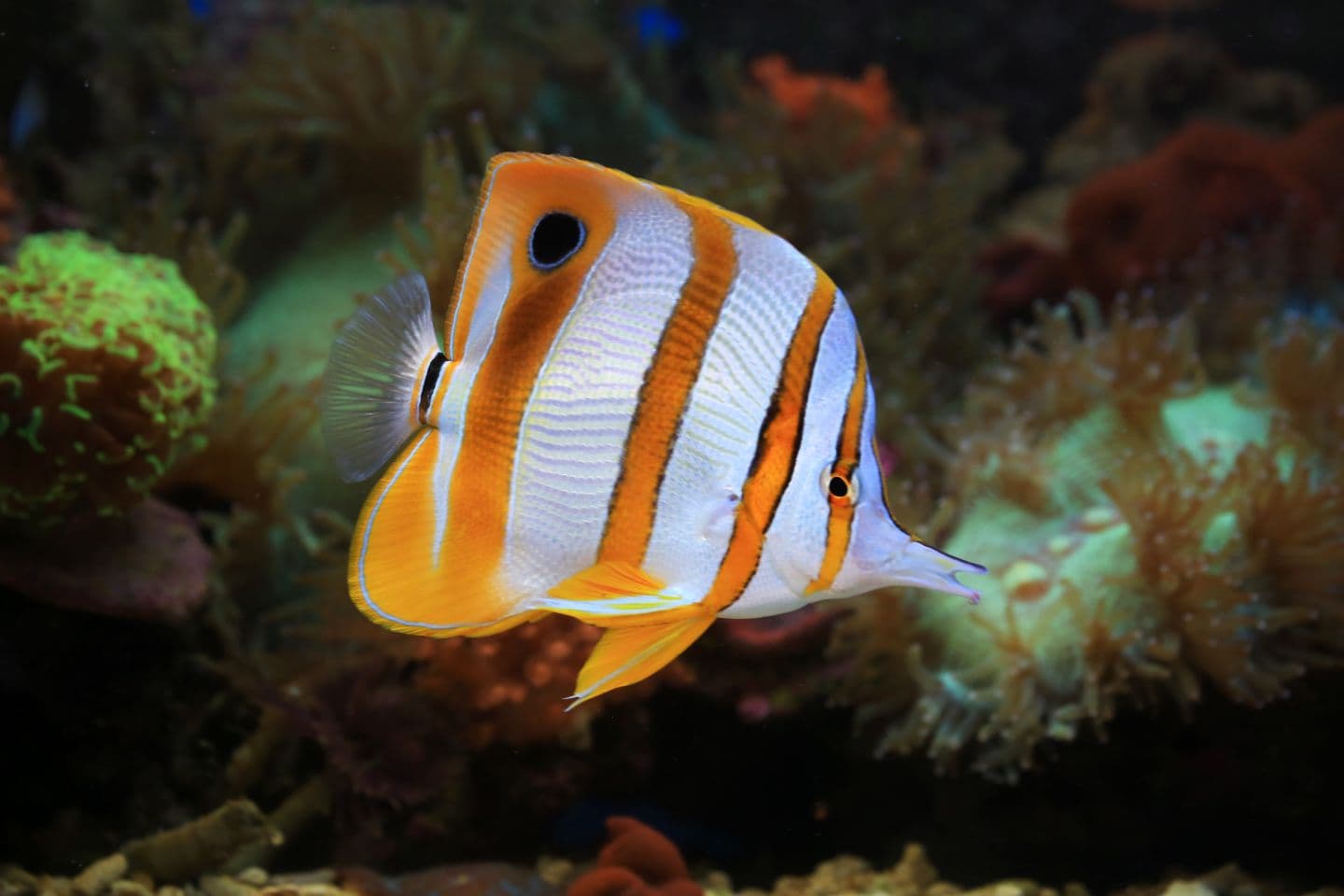
Copperband Butterflyfish (Chelmon rostratus)
Adult size: 6 to 8 inches
Minimum tank size: 75 gallons for one fish, 125 gallons for a pair
Diet: carnivore, live and frozen foods such as mysis and brine shrimp, notoriously reluctant to eat prepared food
Reef compatibility: reef safe with caution, will eat aiptasia but may also pick at LPS and clam mantles
Care level: difficult, not recommended for a first marine fish
With its elegant white body banded in copper orange and a long, slightly upturned snout built for picking prey out of coral crevices, the Copperband Butterflyfish is one of the most requested fish in the hobby purely on looks, and one of the most likely to quietly starve to death in a home aquarium. Newly acquired fish frequently refuse all food for days or weeks, and success usually depends on offering live foods such as brine shrimp or even fresh clam meat on the half shell to trigger a feeding response before slowly weaning the fish onto frozen and prepared diets. Only ever buy one seen actively eating in the dealer's tank. Their range does extend into the Andaman Sea, which is a point of interest for Indian aquarists, though this is not a fish to attempt without real prior experience keeping marine fish and a tank that has been running, stable, for at least six months.
Auriga or Threadfin Butterflyfish (Chaetodon auriga)
Adult size: 8 to 9 inches
Minimum tank size: 100 to 125 gallons
Diet: omnivore, accepts flake, pellet, mysis, brine shrimp and nori readily
Reef compatibility: not reef safe, will nip stony and soft coral, anemones and feather dusters
Care level: easy, one of the more beginner friendly butterflyfish
This species is sold under two different common names in India, Auriga Butterfly and Threadfin Butterfly, but both refer to the same fish, Chaetodon auriga, so do not be tempted to buy one of each thinking you are getting two different species. A predominantly white body carries a chevron pattern of fine black stripes, warming to yellow toward the tail, with a distinctive black eyespot on the dorsal fin that fades as the fish matures and develops the trailing dorsal filament that gives it the threadfin name. It is genuinely one of the easier butterflyfish to keep, adapting to prepared aquarium foods far more readily than fussier relatives like the Copperband, which makes it a sensible entry point for a keeper wanting to try the family for the first time. Keep it away from mixed coral displays regardless of how settled it seems, since its wild diet includes a meaningful amount of coral tissue.
Raccoon Butterflyfish (Chaetodon lunula)
Adult size: up to 8 inches
Minimum tank size: 100 to 125 gallons
Diet: omnivore, accepts frozen and prepared foods well once settled
Reef compatibility: not reef safe, will consume soft coral, zoanthids and anemones
Care level: moderate, hardy but with a distinctly nocturnal habit worth planning around
Named for the dark mask running across its eyes, the Raccoon Butterflyfish is a broadly distributed, adaptable species found from the coast of East Africa right across the Indo Pacific. It is genuinely nocturnal by nature, sheltering under ledges and overhangs through the day in the wild and emerging to feed at dusk, and captive fish often retain a version of that rhythm, so do not be alarmed if a newly introduced specimen seems shy and inactive during daylight hours at first. Once established it is one of the hardier butterflyfish available, adapting well to frozen and prepared foods, though it will happily eat soft coral, zoanthids and anemones given the opportunity, so it belongs in a fish only or fish only with live rock system rather than a mixed reef.
The scissortail rasbora, Rasbora trilineata, gets its name from the black-and-white banded tail fin, which opens and closes in a scissoring motion as the fish swims, a genuinely visible behaviour rath
Flushing a fish, whether dead or simply unwanted, down the toilet is a habit many Indian households have inherited without questioning it, and it carries real risks that are worth understanding.
A cover might seem like an afterthought compared to filtration or lighting, but for a saltwater tank it does real, unglamorous work: cutting evaporation, which matters a great deal given how salinity