Cardinalfish: Gentle Night Swimmers for the Indian Reef Tank
Cardinalfish are among the easiest marine fish to place in a home aquarium. They are small, unhurried, and rarely bother anything else in the tank, which makes them a good match for Indian reef keeper
Cardinalfish are among the easiest marine fish to place in a home aquarium. They are small, unhurried, and rarely bother anything else in the tank, which makes them a good match for Indian reef keepers who want colour and movement without the aggression that comes with many other marine species. Two types dominate the Indian hobby: the Banggai Cardinal and the Pajama Cardinal. Both are mouthbrooders, both are peaceful, and both do best when their owner understands a few quirks before bringing them home.
As a family, cardinalfish are most active at dusk and after dark, so do not be surprised if yours seems shy under bright aquarium lighting and bolder once the lights dim. They also lack the speed and aggression to compete with fast eaters, so feeding routines matter more with cardinalfish than with most other reef fish.
Banggai Cardinal
The Banggai Cardinal (Pterapogon kauderni) is instantly recognisable, with a silver body, bold black stripes, and trailing fins dusted in white spots. It comes from a very small native range around Indonesia's Banggai Islands, which is why wild-caught numbers are a genuine conservation concern. Buying captive-bred stock, which is now widely available, is the better choice for this species.
Care essentials
Tank size: A single fish or a bonded pair can be kept comfortably in a 60 to 115 litre tank. Groups need considerably more space and heavy rockwork to break up sightlines.
Adult size: Reaches about 7 to 9 cm. Growth is slow, so buy on temperament and health rather than size.
Diet: A committed carnivore. Frozen mysis shrimp, brine shrimp, and finely chopped seafood work well. Many individuals are slow to accept dry pellets or flake, so do not rely on these alone in the early weeks.
Temperament: Calm and largely non-aggressive towards other species, but two unrelated adults of its own kind in a small tank will fight, sometimes fatally, once they mature. Keep a single fish, a true pair, or a large enough system for a proper group.
Breeding note: Males carry fertilised eggs in their mouths for around three weeks and cannot feed during this period, so well-conditioned adults going into a spawning attempt matter more than clever aquarium tricks. This is one of the more approachable marine species to breed at home.
A word of caution for Indian buyers: Banggai Cardinals are not native to Indian waters, so all stock sold here is imported, usually via Chennai or Mumbai. Ask your dealer specifically whether the batch is captive-bred, since wild collection from the Banggai Islands remains a sustainability concern that responsible Indian retailers are increasingly avoiding.
Pajama Cardinal
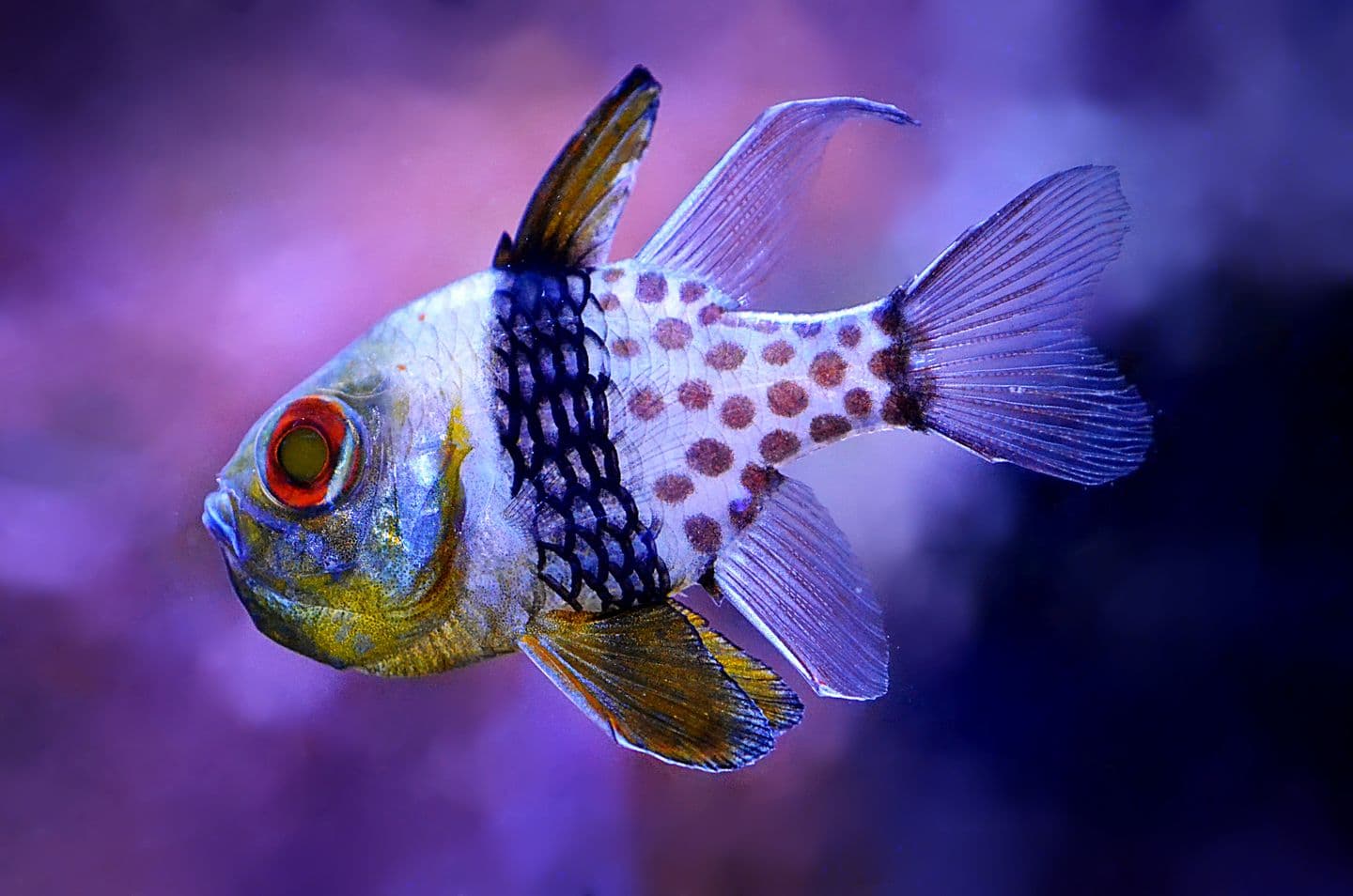
The Pajama Cardinal (Sphaeramia nematoptera) looks like it was designed by committee, and that is part of its charm. A greenish-yellow face and bright red eye sit ahead of a bold black band, followed by a rear half scattered with orange polka dots. It is one of the most laid-back fish in the marine hobby and a genuine beginner favourite.
Care essentials
Tank size: A single fish does well in 75 to 115 litres. A small group needs a larger tank, ideally 200 litres or more, since dominance disputes can develop as the group settles in.
Adult size: Around 8 cm at full growth.
Diet: Carnivorous, taking mysis shrimp, brine shrimp, and finely chopped marine flesh readily. It generally accepts prepared pellets and flake more willingly than the Banggai Cardinal once settled.
Temperament: Very peaceful and slow-moving, which means it should never be housed with fast, boisterous tank mates that will simply out-compete it for food. It also prefers shaded rockwork over bright open water and hides more under intense lighting.
Social structure: A schooling species by nature. A small group of three or more, introduced together, tends to settle better than fish added one at a time.
Interestingly, part of the Pajama Cardinal's natural range stretches into Sri Lankan waters, placing it closer to the Indian coastline than most of the fish typically sold in this hobby. Most Indian aquarium stock is still imported from Southeast Asian and Indonesian exporters, but it is a small point of regional connection worth knowing.
The scissortail rasbora, Rasbora trilineata, gets its name from the black-and-white banded tail fin, which opens and closes in a scissoring motion as the fish swims, a genuinely visible behaviour rath
Flushing a fish, whether dead or simply unwanted, down the toilet is a habit many Indian households have inherited without questioning it, and it carries real risks that are worth understanding.
A cover might seem like an afterthought compared to filtration or lighting, but for a saltwater tank it does real, unglamorous work: cutting evaporation, which matters a great deal given how salinity