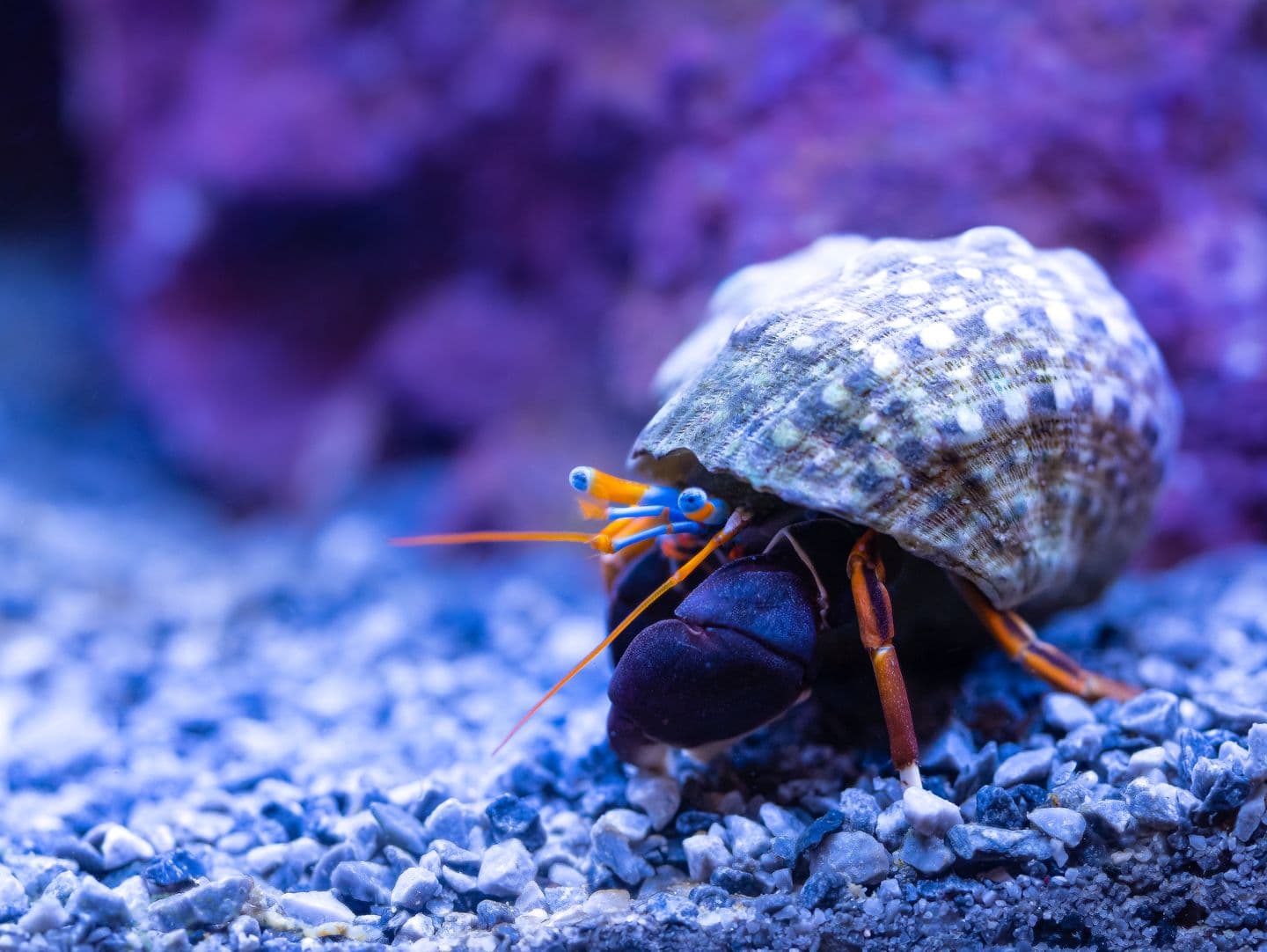
Hermit Crabs for Marine Aquariums: The Cleanup Crew India's Reef Keepers Rely On
Walk into any marine fish store in Mumbai, Chennai or Kochi and you will see small bags of hermit crabs sold almost as an afterthought, tucked in beside the clownfish and coral frags. That undersells
Walk into any marine fish store in Mumbai, Chennai or Kochi and you will see small bags of hermit crabs sold almost as an afterthought, tucked in beside the clownfish and coral frags. That undersells them. Hermit crabs are one of the hardest working members of a reef cleanup crew, grazing algae off glass and rock around the clock while most of the tank sleeps. They are not true crabs. A hermit crab has a soft, curled abdomen with no hard shell of its own, so it borrows an empty snail shell for protection and swaps it for a bigger one as it grows. This single habit shapes almost everything about keeping them well. Below are the three types most commonly available to Indian reef keepers, imported through the same channels as marine fish since none of them occur naturally along the Indian coast.
Blue Leg Hermit Crab
The Blue Leg Hermit Crab (Clibanarius tricolor) is the entry point for most Indian hobbyists building a cleanup crew, and for good reason. It is inexpensive, widely stocked, and among the most effective algae grazers available for a reef tank. The body is small, rarely growing past two to three centimetres, with bright blue legs that stand out clearly against live rock. It spends its day working over hair algae, diatoms and film algae on rock and substrate, and copes well with the swings in water quality that a new Indian reef tank often goes through in its first few months.
Keep water temperature between 22 and 26 degrees Celsius, pH from 8.0 to 8.5, and specific gravity around 1.020 to 1.025, the same range most reef fish and corals need, so there is nothing extra to manage here. A ten gallon tank can comfortably hold two to three of these crabs, and as a rule of thumb, one crab per three to four gallons keeps the group from squabbling over shells as they grow. This is the one genuine caution with Blue Legs: despite being labelled reef safe, they will attack live snails, particularly cerith snails, purely to take over a shell they fancy. Keep a stock of empty spare shells of varying sizes scattered through the tank at all times. It will not eliminate the behaviour entirely, but it removes most of the motive.
Scarlet Hermit Crab
The Scarlet Hermit Crab (Paguristes cadenati), sometimes sold as the Scarlet Reef Hermit or Red Legged Hermit, is the crab most Indian hobbyists add purely for looks, since its bright red legs and body add real colour against a mixed reef aquascape. It grows slightly larger than the Blue Leg, reaching around four centimetres, and is a similarly capable grazer of algae, detritus and leftover food. Where it genuinely earns its higher price over the Blue Leg is temperament: Scarlet Hermits are far gentler on snails and rarely go shell hunting the way Blue Legs do, which makes them a safer pairing in a tank that already has a healthy Trochus or Turbo snail population.
Parameters match any standard reef setup, 22 to 27 degrees Celsius and a specific gravity of 1.023 to 1.026. Expect a lifespan of two to four years with steady care, longer than most hobbyists assume from such a small animal. They are omnivorous scavengers, so alongside algae they will happily clean up meaty leftovers, dried seaweed and sinking pellets when natural algae growth in the tank runs low. Avoid overstocking, since Scarlets can turn territorial with each other when shells and food both run short.
Halloween Hermit Crab
The Halloween Hermit Crab (Ciliopagurus strigatus) is the largest and most striking of the three, with bold orange and black banded legs that genuinely resemble a Halloween costume, hence the name. It is also the one that needs the most thought before adding to a mixed reef tank. Halloween Hermits grow noticeably larger than Blue Legs or Scarlets and are considerably more active climbers, which means they can and do bump corals and knock over unsecured frags while foraging at night.
Because of their size, give them a tank of at least twenty gallons and keep the group small, one or two per tank is usually enough since they compete aggressively with each other over shells as they grow. They favour cone shaped shells rather than the spiral shells preferred by Blue Legs and Scarlets, so keep a mix of shell shapes on hand, and note that this shell preference is actually useful: Halloween Hermits sharing a tank with Blue Legs or Scarlets rarely fight over shells since neither wants what the other is after. Feed a slightly more varied diet than the smaller species, since larger hermits want more protein, meaty scraps, shrimp bits or a marine pellet, alongside their algae grazing. One thing worth flagging plainly since it often gets buried under enthusiastic sales copy: keep Halloween Hermits only in a tank where you are comfortable with an active, curious crab moving through your coral, not a delicate SPS dominated display.
A quick word on sourcing in India
None of these three species are native to Indian reefs, so every specimen sold here has been imported, usually through the same Chennai or Mumbai import chains that bring in marine fish. Buy from a dealer who can show healthy, active stock rather than crabs sitting motionless at the bottom of a bag, since hermit crabs travel poorly when stressed and a listless crab rarely recovers once added to a new tank. Quarantine is less critical for hermit crabs than for fish, but a short observation period in a bare bottom tank lets you confirm the crab is active and feeding before it goes anywhere near your display.
The scissortail rasbora, Rasbora trilineata, gets its name from the black-and-white banded tail fin, which opens and closes in a scissoring motion as the fish swims, a genuinely visible behaviour rath
Flushing a fish, whether dead or simply unwanted, down the toilet is a habit many Indian households have inherited without questioning it, and it carries real risks that are worth understanding.
A cover might seem like an afterthought compared to filtration or lighting, but for a saltwater tank it does real, unglamorous work: cutting evaporation, which matters a great deal given how salinity