Anemones divide reef keepers more than almost any other group of animals in the hobby. Get one right and it becomes the centrepiece of the tank, often with a pair of clownfish weaving through its tent
Anemones divide reef keepers more than almost any other group of animals in the hobby. Get one right and it becomes the centrepiece of the tank, often with a pair of clownfish weaving through its tentacles for years. Get one wrong, through poor lighting, an unstable tank or the wrong species for a beginner, and it can decline quietly for weeks before collapsing all at once, taking water quality down with it. None of the six anemones below are difficult by accident; each has a specific reputation in the hobby, and it is worth knowing which is which before buying.
Bubble Tip, Rose Bubble Tip and Rainbow Bubble Tip Anemone (Entacmaea quadricolor)
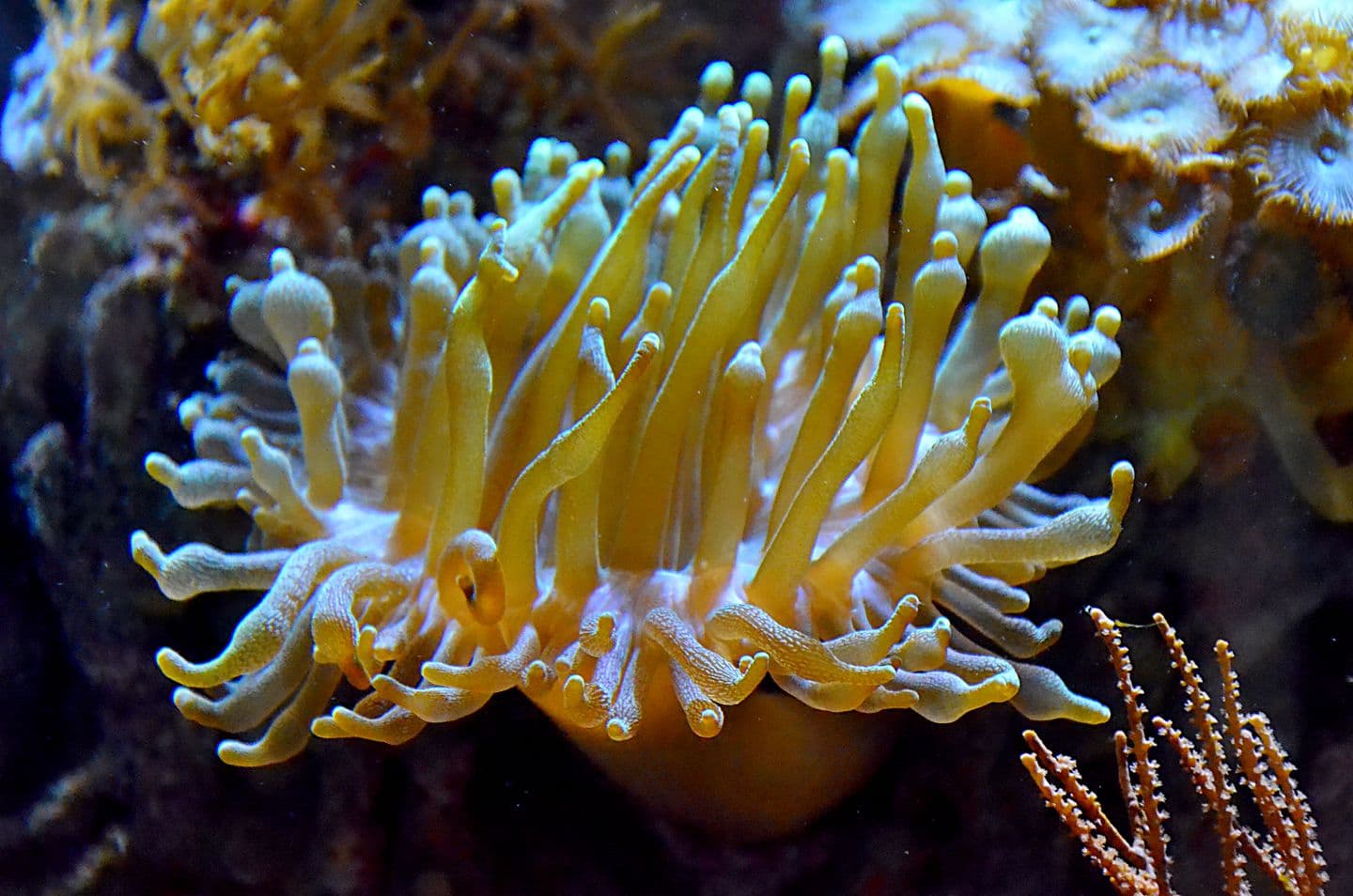
These three names all describe the same species, Entacmaea quadricolor, distinguished only by colour morph, and it is worth being upfront about that before anyone buys what they think are three different anemones. The standard Bubble Tip Anemone is widely regarded as the most forgiving host anemone in the hobby, with distinctive bulbous swellings at the tips of its tentacles that give the species its name. The Rose form carries a solid dusty pink to red colouration with no green in a genuine specimen, though sellers loosely label almost any reddish individual as rose. The Rainbow form shows a striking gradient, typically a blue-green base fading through orange into pink or red tips, and is usually the most expensive and sought-after of the three.
Tank size: minimum 115 litres in an established tank, at least 6 months old
Lighting: moderate to high; brighter light tends to intensify colour and encourage the bubble formation, while low light produces longer, stringier tentacles without bubbles
Water flow: medium, enough to keep tentacles moving without folding them over
Feeding: 2 to 3 times a week with chopped shrimp, mussel or a prepared meaty invertebrate food; a hosting clownfish also feeds the anemone through waste and leftover scraps
Clownfish hosting: one of the widest hosts in the hobby, taken up by ocellaris, percula, clarkii, tomato, cinnamon, fire and maroon clownfish among others
Reproduction: splits naturally through longitudinal fission when healthy, which is how many aquarium colonies build up over time without further collection
This anemone does move if it dislikes its spot, so do not force a placement; give it rockwork with a crevice to wedge its foot into and let it choose. Colour intensity is influenced heavily by lighting and feeding, so a green specimen bought as a rose or rainbow morph under different lighting is a common and genuine cause of buyer disappointment rather than a fraud, which is worth knowing going in.
Long Tentacle Anemone (Macrodactyla doreensis)
Also sold as the Corkscrew Anemone or Sand Anemone, this species buries its foot in a sandy substrate near rockwork and leaves only its long, well-spaced tentacles exposed above the surface. The oral disc can reach up to 50 centimetres across in mature specimens, with a base that is usually orange to red and tentacles ranging from brown or green to striped patterns, occasionally purple in rarer forms.
Tank size: minimum 115 litres with at least 10 centimetres of sand or rubble substrate
Lighting: moderate to high
Water flow: medium
Feeding: meaty foods such as shrimp, mussel or fish pieces 2 to 3 times a week
Clownfish hosting: commonly hosts skunk clownfish, clarkii and Barrier Reef clownfish among others
Substrate caution: avoid crushed coral, which can cut the foot; a fine sand or mud bed is safer
The tentacles carry a stronger sting than a Bubble Tip's, strong enough to catch small fish, so give it distance from fish that are not adapted to anemones and from corals it could reach if it decides to relocate.
Most references describe the species as Pacific-centred, ranging from southern Japan down through Indonesia and New Guinea to northern Australia, though one detailed species account extends that range as far west as Mauritius in the western Indian Ocean. Given the conflicting descriptions, it is safest to treat this as a Pacific-leaning Indo-Pacific species rather than claim a firm Indian coastline connection; virtually all specimens sold in India arrive through Southeast Asian import channels regardless.
Rock Flower Anemone (Epicystis crucifer)
The Rock Flower Anemone is worth including precisely because it breaks the usual pattern. It does not host clownfish at all, its native range is the Caribbean rather than the Indo-Pacific most marine livestock on this list comes from, and it is one of the genuinely easiest anemones to keep. Its flat, disc-shaped body is ringed with roughly 200 short beaded tentacles and comes in an enormous range of colour combinations, no two specimens quite alike.
Tank size: works even in smaller nano reefs, 40 litres upward
Lighting: moderate, 150 to 250 PAR, more forgiving than most anemones on light intensity
Water flow: low to moderate
Feeding: small meaty foods 2 to 3 times a week; also draws some nutrition from zooxanthellae
Clownfish hosting: none; do not expect or attempt to pair this species with clownfish
Adult size: typically 10 to 15 centimetres across, occasionally reaching 20 to 25 centimetres in older specimens, and slow growing throughout
Placement: stays put once settled, unlike wandering species; the main risk is damage to the foot during handling or shipping, which is the leading cause of early death
Because it stays anchored and does not sting aggressively, several Rock Flower Anemones can be kept in a group without them stinging each other, something that is simply not possible with most other anemone species. For a reef keeper who wants anemone colour and movement without the wandering risk of a Bubble Tip or Long Tentacle, this is the safer entry point, even though it will never host a clownfish.
Sebae Anemone (Heteractis crispa)
The Sebae, sometimes called the Leather Anemone, is one of the most commonly imported host anemones and also one of the most misleadingly labelled. Its long, slender tentacles usually run greenish, violet or tan, occasionally with distinctive blue or purple tips. It genuinely deserves a middle-of-the-road care rating, not the beginner tag it is sometimes given, and not purely because of care difficulty but because of how it typically arrives in the trade.
Tank size: minimum 190 litres, this species grows large, with an oral disc that can flare to 50 centimetres across
Lighting: strong, among the higher light requirements on this list
Water flow: moderate to high
Feeding: meaty foods weekly to twice weekly; it is capable of catching and eating small fish in the wild, so keep very small tankmates in mind
Clownfish hosting: one of the most widely used host species, taken up by clarkii, chrysopterus, polymnus and several others
The frank warning worth repeating here: a large share of Sebae Anemones reach retailers already bleached white or pale yellow from poor handling in transit, having lost the symbiotic algae that gives them both colour and much of their nutrition. A bleached specimen is not simply less attractive, it is often already past the point of recovery, with survival rates in the range of only 6 to 8 months even under good care. Buying a healthy brown, tan or green specimen rather than a striking white one is a genuine welfare decision, not just an aesthetic preference, and it is worth saying plainly rather than glossing over.
Its native range runs from the Red Sea across the East African coast through to Japan, Australia and Polynesia, which puts it broadly within Indo-Pacific and western Indian Ocean waters even though imported stock in India still arrives mainly via Southeast Asian collection and export channels. One naming mix-up worth clearing up for Indian buyers: there is a separate fish called the Sebae Clownfish (Amphiprion sebae), native to the northern Indian Ocean from the Arabian Sea to Java, whose name suggests a pairing with this anemone. In the wild it actually hosts far more often in the Saddle Carpet Anemone (Stichodactyla haddoni) than in the true Sebae Anemone described here, so the shared name is not a reliable guide to which anemone suits which clownfish.
The scissortail rasbora, Rasbora trilineata, gets its name from the black-and-white banded tail fin, which opens and closes in a scissoring motion as the fish swims, a genuinely visible behaviour rath
Flushing a fish, whether dead or simply unwanted, down the toilet is a habit many Indian households have inherited without questioning it, and it carries real risks that are worth understanding.
A cover might seem like an afterthought compared to filtration or lighting, but for a saltwater tank it does real, unglamorous work: cutting evaporation, which matters a great deal given how salinity