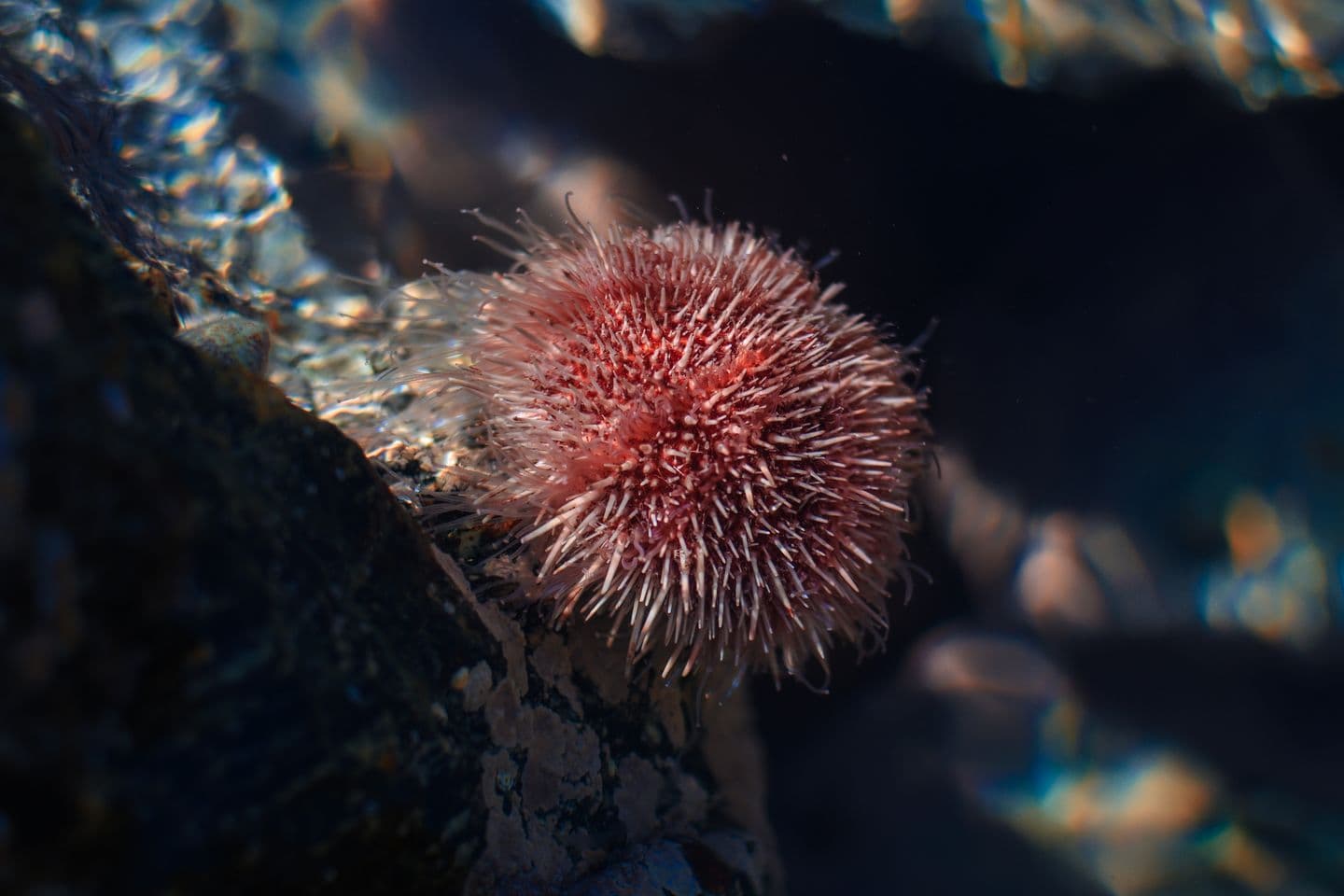
Sea urchins rarely get the attention corals and fish do, yet a healthy urchin does more unglamorous cleanup work than almost anything else in the tank. They graze constantly, they cannot be overfed th
Sea urchins rarely get the attention corals and fish do, yet a healthy urchin does more unglamorous cleanup work than almost anything else in the tank. They graze constantly, they cannot be overfed the way fish can, and a good one will patrol glass and rockwork that no snail bothers with. Only two urchins show up with any regularity in the Indian marine trade, and they could not be more different from each other in temperament and risk.
Tuxedo Urchin (Mespilia globulus)
The Tuxedo Urchin is the urchin most reef keepers should actually start with. Its shell rarely exceeds 7 to 8 centimetres and it stays close to that size in captivity, usually settling around 5 centimetres. The name comes from the broad velvety bands, blue to black in the common form and reddish in a less common colour variant, running between rows of short, blunt spines that are nowhere near as intimidating as those on a long spine urchin.
Tank size: comfortable from 60 litres upward, one urchin per 115 to 190 litres depending on how much algae the tank produces
Diet: film algae, hair algae and coralline algae, supplemented with dried seaweed sheets or algae wafers if the tank runs too clean
Water parameters: stable reef parameters, temperature 24 to 26°C, pH 8.1 to 8.4; this species is genuinely sensitive to sudden salinity swings, so acclimatise slowly
Reef safety: considered reef safe, will not deliberately harm corals, though it can dislodge unglued frags while moving
Lifespan: 1 to 3 years in a well-run tank
A quirk worth knowing before buying one: Tuxedo Urchins pick up shell fragments, bits of rubble and loose coral frags and carry them around as camouflage, a habit called covering. If an established urchin suddenly stops covering itself, it is usually the first sign that something in the water has gone wrong, so treat it as an early warning rather than an oddity. Because the species eats through coralline algae along with nuisance growths, keepers who prize a fully encrusted pink and purple rockscape may want to supplement feeding so the urchin is not tempted to strip it bare.
The Tuxedo Urchin is one of the very few reef invertebrates on this list with a genuine claim to India. Its natural range runs right across the Indian Ocean, and while nearly all specimens sold here still arrive through import channels via Mumbai, Chennai and Kochi rather than from domestic collection, the species itself is not a stranger to Indian coastal waters the way most tank inhabitants are.
Long Spine Urchin (Diadema setosum)
The Long Spine Urchin is the dramatic cousin, a jet black animal with slender spines that can reach 10 to 25 centimetres from tip to tip, several times the diameter of the body itself. A pale blue or white ring circling the base of the spines and a small red spot on top are the easiest identification marks. This is not a beginner's urchin. It needs a larger, more mature tank, at least 190 litres and ideally closer to 300, and it comes with a genuine safety consideration that Tuxedo Urchins do not.
Tank size: sources vary widely here, from a 190 litre minimum to a 470 litre recommendation for a fully grown specimen; given the spine spread, err toward the larger figure rather than the smaller one
Diet: herbivorous, eats green hair algae, red algae and diatoms readily; supplement with nori or algae pellets in low-algae tanks
Water parameters: temperature 22 to 26°C, pH 8.1 to 8.4, specific gravity 1.023 to 1.025; stability matters more than any single number
Reef safety: generally considered reef safe but can be a bulldozer around delicate coral placements, better suited to fish-only or robust reef setups
Handling: spines are not venomous but can puncture skin and break off under it, causing irritation and occasional infection; use a container rather than bare hands or a net during any tank work
Frankly, the spines are the whole story with this species. They are sharp enough to go straight through a thin aquarium glove, and broken-off spine tips left in skin can fester if not removed properly. Anyone doing maintenance in a tank housing this urchin should know exactly where it is before reaching in, and it is worth keeping tweezers and antiseptic on hand rather than treating this as a remote possibility.
There is a genuine India connection here too, and a stronger one than most saltwater species on this list can claim. Diadema setosum occurs naturally along stretches of the Indian coastline, including the Andaman and Lakshadweep waters, which makes it one of the few marine aquarium species in this entire series that is not purely an import from Southeast Asian or Pacific reefs.
The scissortail rasbora, Rasbora trilineata, gets its name from the black-and-white banded tail fin, which opens and closes in a scissoring motion as the fish swims, a genuinely visible behaviour rath
Flushing a fish, whether dead or simply unwanted, down the toilet is a habit many Indian households have inherited without questioning it, and it carries real risks that are worth understanding.
A cover might seem like an afterthought compared to filtration or lighting, but for a saltwater tank it does real, unglamorous work: cutting evaporation, which matters a great deal given how salinity