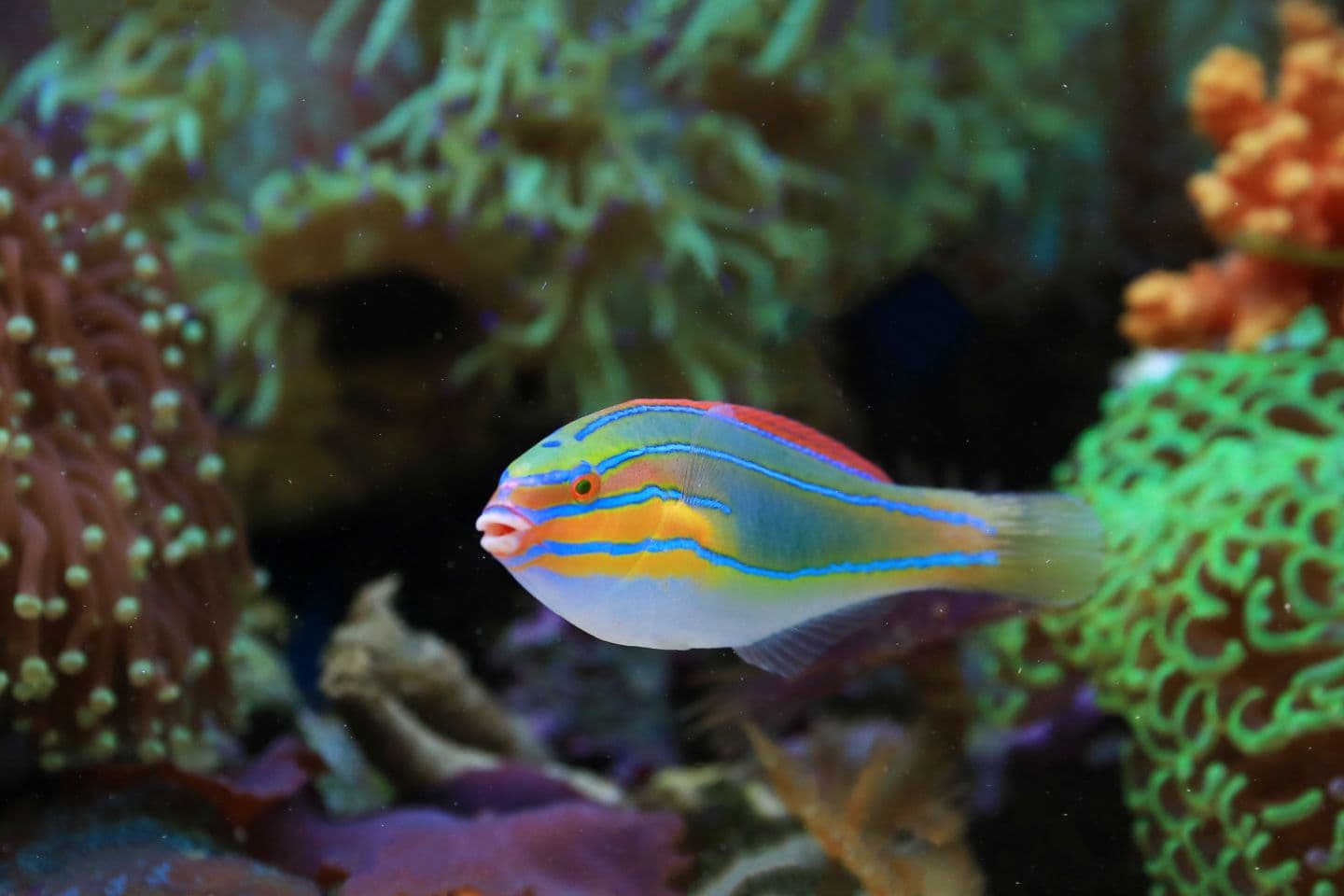
Wrasses for the Indian Marine Aquarium: A Category Guide
Wrasses belong to the family Labridae, one of the largest reef fish families in the world, and are prized for constant activity, striking colour, and genuine usefulness against pest invertebrates such
Wrasses belong to the family Labridae, one of the largest reef fish families in the world, and are prized for constant activity, striking colour, and genuine usefulness against pest invertebrates such as flatworms, bristleworms and pyramidellid snails. Almost every wrasse is a capable jumper, so an airtight lid is compulsory whichever species you keep, and a number of species sleep buried in a soft sand bed at night, which means fine substrate is a functional requirement for this group rather than a decorative extra. The four species below range from genuinely easy to a fish that deserves a clear warning before purchase.
Six Line Wrasse (Pseudocheilinus hexataenia)
The Six Line Wrasse has a purple-blue body carrying six horizontal orange or yellow stripes, a green tinged tail with a dark eyespot at its base to confuse predators, and stays small at around 7 to 8 centimetres. Its natural range runs from the Red Sea through the Indo-Pacific and includes waters along the Indian coastline, so this is genuinely a local species for Indian reef keepers, even though most aquarium stock is still imported through the trade rather than sourced domestically.
A tank of 115 to 200 litres with generous rockwork and hiding spots suits it well. Standard reef parameters apply, and it does well toward the slightly warmer end, around 24 to 27 degrees Celsius. It is semi aggressive and should be added last to an established tank, since it can bully more timid fish added after it; keep only one per tank unless the system is very large. It is reef safe and actively hunts bristleworms, flatworms and the pyramidellid snails that prey on clams. It is not a fussy eater and readily accepts standard frozen and prepared marine foods, also grazing live rock between meals. It has a reputation as a poor shipper, so ask for a specimen that is already feeding well, and quarantine it carefully before introducing it to the main tank, a real consideration when ordering online across Indian distances.
Melanurus Wrasse (Halichoeres melanurus)
Also called Hoeven's Wrasse or the Tail Spot Wrasse, males of this species display a striking mix of blue, green, yellow and red stripes with a black and yellow spot on the tail, while females are duller silvery blue with yellow stripes and a dorsal eyespot. It grows to around 11 to 12 centimetres and is widely considered one of the best all round beginner wrasses for reef pest control.
It needs a tank of 200 litres or more with at least 7 to 10 centimetres of fine, soft sand, because this species dives into the sand every night to sleep and whenever it feels threatened, and coarse or sharp substrate can injure it as it burrows. New arrivals often bury themselves for the first week or longer, which is completely normal, and the fish should never be dug out. Standard reef parameters apply. It is peaceful toward most tankmates, though it may spar with similarly shaped wrasses, and it is reef safe, hunting flatworms, bristleworms and small pest snails. It is worth knowing that it will also eat small ornamental shrimp and hermit crabs, which matters when planning a clean up crew alongside it. Feed frozen mysis, brine shrimp and chopped seafood two to three times daily.
Yellow Coris Wrasse (Halichoeres chrysus)
Also known as the Canary Wrasse, this species has a bright canary yellow body with a single black eyespot on the front dorsal fin in adults; juveniles sometimes show more than one spot, which fades with maturity. It grows to around 12 to 13 centimetres and needs a tank of 200 litres or more with a soft sand bed at least 5 centimetres deep for sleeping and diving to safety, along with ample live rock.
Standard reef parameters apply, and this species does well with moderately strong flow. It is peaceful and notably shy, one of the calmer pest controlling wrasses, and mixes well with other community reef fish, including other wrasse species in a large enough system, which sets it apart from the more combative Six Line Wrasse. It is reef safe and actively hunts flatworms, pyramidellid snails and small nudibranchs that damage coral. It is a strict carnivore and needs a steady offering of chopped seafood, mysis and enriched brine shrimp several times a day, moving on to flake and pellet food once settled. A genuinely secure mesh lid is essential, since this species is a committed jumper, particularly in the first weeks after introduction.
Cleaner Wrasse (Labroides dimidiatus)
Commonly called the Bluestreak Cleaner Wrasse, this species has a slender body carrying a black horizontal band the full length from nose to tail, blue above and white below, and grows to around 10 centimetres. In the wild it runs a genuine cleaning station on the reef, removing parasites, dead tissue and mucus from other fish that queue up and wait their turn, a well documented and ecologically important relationship.
This is also the fish in this article that deserves the clearest warning before purchase. It has one of the worst survival records of any commonly sold marine fish, because its feeding behaviour is so specialised that most individuals never adapt to prepared aquarium foods and slowly starve over weeks or months, even in experienced hands. It genuinely needs an established, heavily stocked tank of 400 litres or more carrying enough fish with the parasite and mucus load it would normally clean, or a keeper committed to offering copepods, amphipods and enriched frozen foods multiple times a day indefinitely. It should be kept singly or as one bonded pair, never as two of the same sex.
Given how often this fish dies of starvation in home aquariums, most experienced marine keepers now suggest a Bicolor cleaner shrimp, or the captive-bred Neon Goby covered earlier in this series, as a far more reliable way to bring a cleaning presence into an Indian reef tank, rather than the Cleaner Wrasse itself.
The scissortail rasbora, Rasbora trilineata, gets its name from the black-and-white banded tail fin, which opens and closes in a scissoring motion as the fish swims, a genuinely visible behaviour rath
Flushing a fish, whether dead or simply unwanted, down the toilet is a habit many Indian households have inherited without questioning it, and it carries real risks that are worth understanding.
A cover might seem like an afterthought compared to filtration or lighting, but for a saltwater tank it does real, unglamorous work: cutting evaporation, which matters a great deal given how salinity