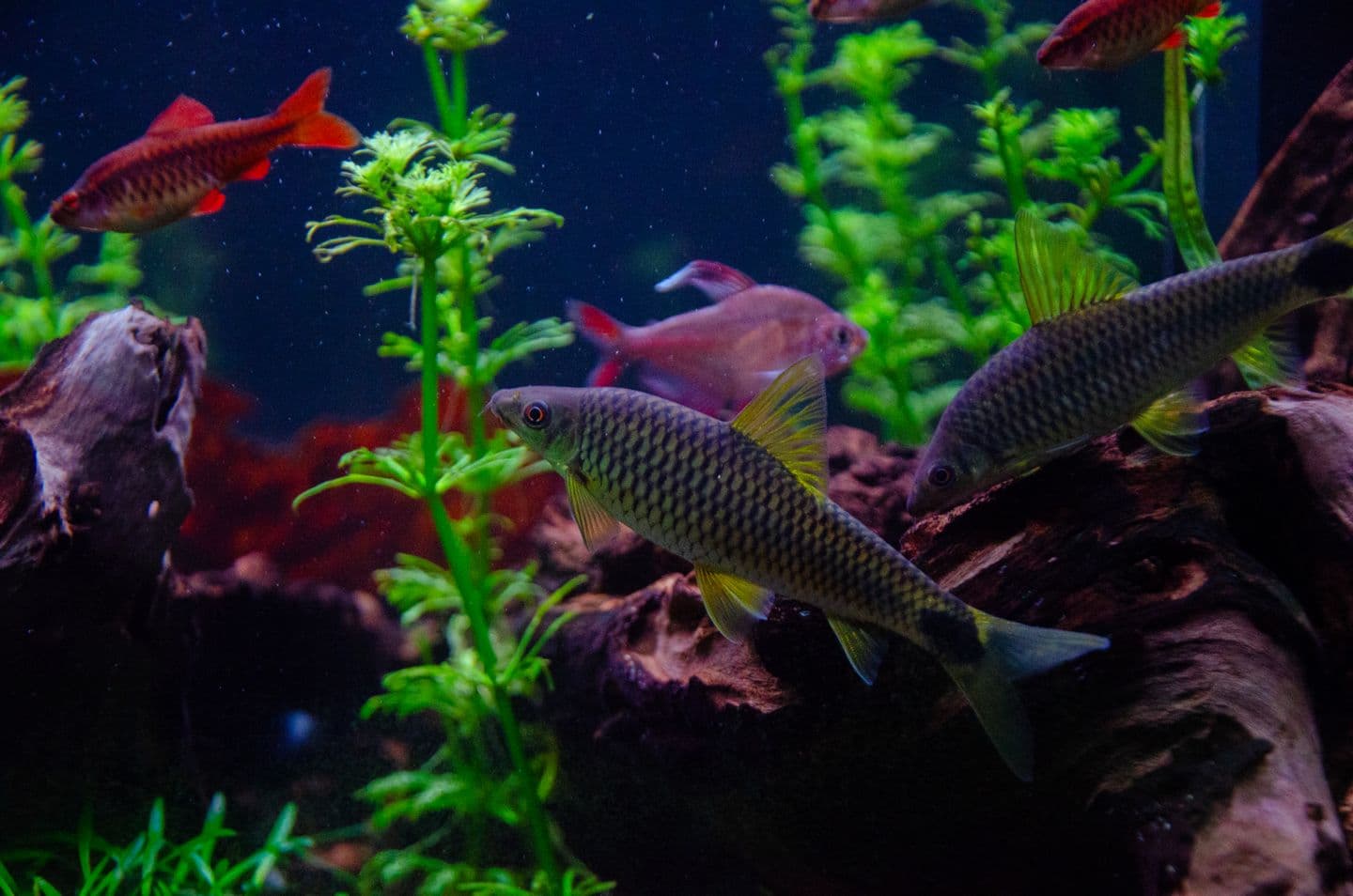
The Denison barb, also widely sold as the roseline shark, is a torpedo-shaped fish with a bold red-and-black stripe running from nose to tail and yellow-black banding on the fork of the tail. It is en
The Denison barb, also widely sold as the roseline shark, is a torpedo-shaped fish with a bold red-and-black stripe running from nose to tail and yellow-black banding on the fork of the tail. It is endemic to a handful of fast-flowing hill streams in the Western Ghats of Kerala and Karnataka, and reaches around twelve to fifteen centimetres.
This is a species genuinely worth knowing the full story of before buying. Its striking looks made it enormously popular from the 1990s onward, and by 2007 it accounted for around sixty per cent of all live ornamental fish exported from India. That same popularity, combined with habitat loss from dams and pollution, has pushed wild populations into a genuine crisis, and the species is now listed as Endangered by the IUCN.
Tank and water requirements
Given its size and very active swimming style, a group of six or more needs a tank of at least a hundred and fifty litres with strong water flow and high oxygen levels, reflecting its home in fast hill streams. It does best on the cooler side of the tropical range and does not thrive in warm, still water.
A secure lid is essential, since Denison barbs are strong jumpers, and the tank should offer plenty of open swimming length rather than dense obstruction.
Diet, sourcing and a conservation note
An omnivorous diet of good-quality flakes or pellets, supplemented with live or frozen food and some vegetable matter, suits it well. It is a shoaling fish and settles poorly, sometimes becoming skittish or stressed, if not kept in a proper group of six or more.
The Kerala government has introduced fishing restrictions to protect wild stock, and most fish reaching the trade today, including much of what is sold in India, is commercially bred rather than wild caught. Buying only captive-bred stock, and asking a shop directly where its fish come from, is a genuinely meaningful choice with this particular species.
Buying tips
Priced around one hundred to three hundred rupees per fish in India, reflecting its popularity and the cost of proper captive breeding
Ask specifically about captive-bred stock given the species' endangered wild status
A fish worth talking about as a genuinely Indian species with a real conservation story, not just another imported barb
The scissortail rasbora, Rasbora trilineata, gets its name from the black-and-white banded tail fin, which opens and closes in a scissoring motion as the fish swims, a genuinely visible behaviour rath
Flushing a fish, whether dead or simply unwanted, down the toilet is a habit many Indian households have inherited without questioning it, and it carries real risks that are worth understanding.
A cover might seem like an afterthought compared to filtration or lighting, but for a saltwater tank it does real, unglamorous work: cutting evaporation, which matters a great deal given how salinity