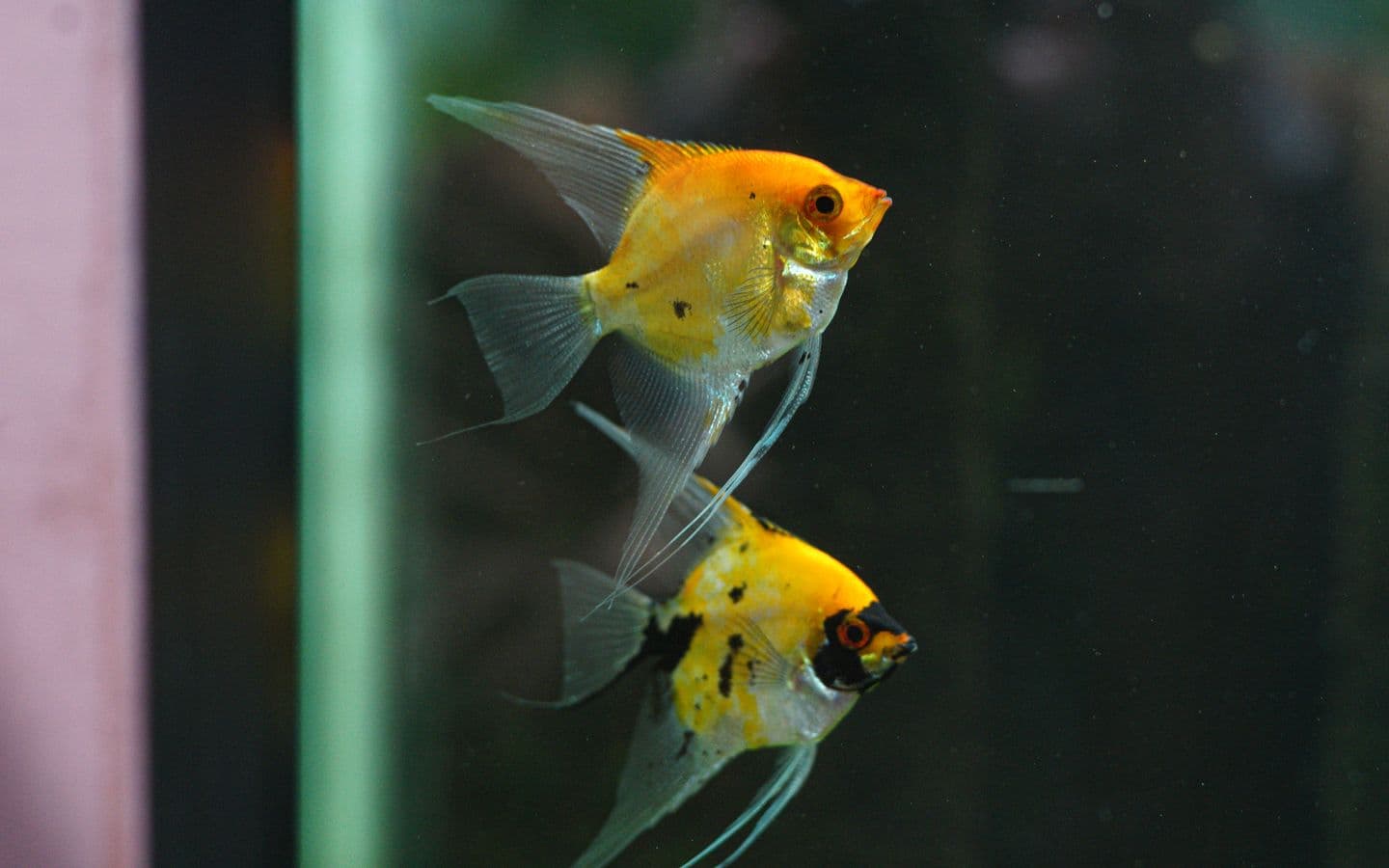
Freshwater Angelfish: A Cichlid That Doesn't Look the Part
The freshwater angelfish is one of the most recognisable aquarium fish in the world, with its tall, laterally flattened, almost diamond-shaped body and long trailing fins setting it apart from every o
The freshwater angelfish is one of the most recognisable aquarium fish in the world, with its tall, laterally flattened, almost diamond-shaped body and long trailing fins setting it apart from every other fish on this list. Despite its calm, graceful look, it is actually a cichlid, related to far more aggressive fish such as the Oscar, and carries some of that family's territorial instincts, especially when breeding.
It comes from slow-moving stretches of the Amazon basin and, unusually for its striking silhouette, reaches a body length of around fifteen centimetres, but its long dorsal and anal fins push its total height well beyond that, often to twenty centimetres or more from fin tip to fin tip. Angelfish are naturally taller than they are long, which is easy to forget when judging tank height from the body alone. With good care they can live a genuinely long time for an aquarium fish, often eight to twelve years.
Tank requirements
Given its height and finnage, an angelfish needs a genuinely tall tank, at least sixty centimetres in height, with a minimum volume of a hundred litres for a single fish or a mated pair, more for a small group of juveniles being raised together. Standard, shallow tanks undersell how much vertical space this fish actually needs.
Broad-leaved plants such as amazon sword or large driftwood pieces make good use of its natural mid-water swimming style and echo its wild habitat.
Diet and behaviour
A varied diet of good-quality cichlid pellets or flakes, supplemented with occasional live or frozen bloodworm and brine shrimp, keeps angelfish healthy and well coloured. They are not fussy eaters once settled.
Angelfish are peaceful with similarly sized fish as juveniles but can become territorial and even aggressive once paired up and breeding, particularly towards other angelfish or fish that resemble their own fry in size. Very small fish, including neon tetras once they have grown large enough to appeal to an adult angelfish's appetite, are sometimes eaten rather than simply chased off.
Buying tips
Priced widely in India, from around fifty rupees for common silver juveniles to several hundred for marble, koi or platinum colour varieties
Buy the tallest tank you can manage rather than a standard shallow one, given how much this fish actually needs vertically
Be cautious mixing with very small tankmates such as neon tetras, since a mature, breeding angelfish may eventually see them as food rather than company
The scissortail rasbora, Rasbora trilineata, gets its name from the black-and-white banded tail fin, which opens and closes in a scissoring motion as the fish swims, a genuinely visible behaviour rath
Flushing a fish, whether dead or simply unwanted, down the toilet is a habit many Indian households have inherited without questioning it, and it carries real risks that are worth understanding.
A cover might seem like an afterthought compared to filtration or lighting, but for a saltwater tank it does real, unglamorous work: cutting evaporation, which matters a great deal given how salinity