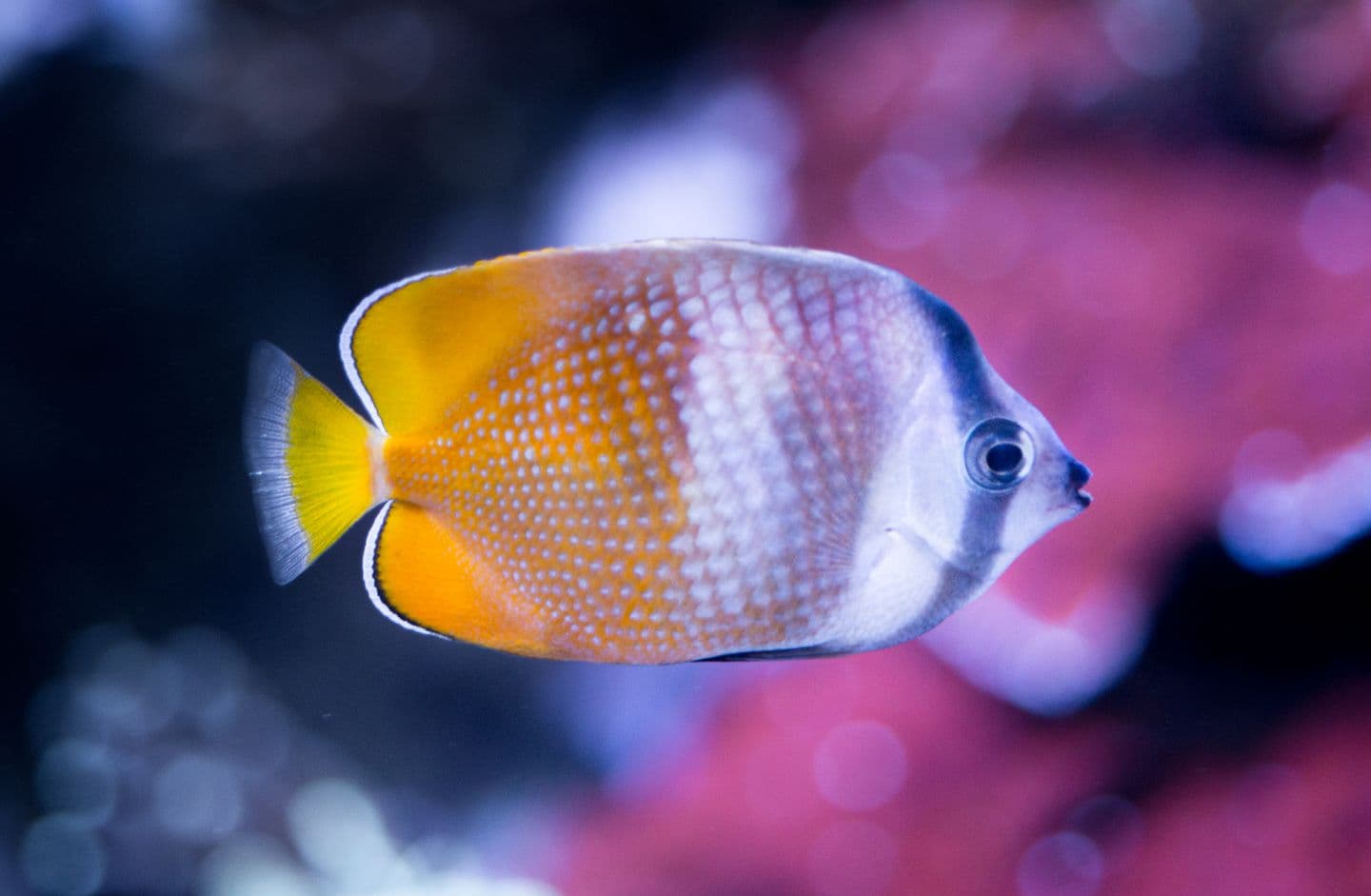
Freshwater Butterflyfish: A Surface Ambush Predator
The freshwater butterflyfish has a flattened, upward-facing mouth and broad, wing-like pectoral fins that give it its name, spending nearly all its time motionless at the water's surface waiting to am
The freshwater butterflyfish has a flattened, upward-facing mouth and broad, wing-like pectoral fins that give it its name, spending nearly all its time motionless at the water's surface waiting to ambush insects that land or fall in. It comes from West and Central Africa and reaches around ten to twelve centimetres.
Its large pectoral fins are genuinely functional rather than just decorative: this fish can leap clear of the water and glide short distances using them, a real adaptation for catching flying insects and escaping predators, similar in principle to the hatchetfish covered later in this series. Ichthyologists actually debate the precise mechanics, with some describing it as a true glider that wiggles its fins mid-air and others as a powerful ballistic jumper rather than a sustained glider, but either way the leaping ability itself is genuine and well documented, not an exaggeration.
Tank and water requirements
A single fish or small group does well in a tank of eighty litres or more, with plenty of surface area and floating plants that mimic the still, vegetated surface waters it favours in the wild. A tightly fitting lid is essential, since this fish is a genuinely strong and frequent jumper.
It tolerates a reasonable range of water conditions, including typical Indian tap water, and prefers calm surface water rather than strong filtration flow disturbing the top of the tank.
Diet and a tankmate warning
In the wild it feeds almost exclusively on insects that land on the water's surface, and in the aquarium it does best on floating pellets, crickets, and other surface-delivered live or frozen food, since it rarely if ever feeds from the middle or bottom of the tank.
It is a genuine predator of any fish small enough to fit in its considerable mouth, so small surface-dwelling tankmates such as small danios or rasboras are at real risk, while larger, deeper-swimming community fish that stay out of its strike zone make safer companions.
Buying tips
Priced around eighty to two hundred rupees per fish in most Indian shops that stock African specialty fish
Provide floating plants and a secure lid specifically to suit this fish's natural surface-dwelling, jumping behaviour
Avoid small surface-dwelling tankmates given this fish's genuine predatory reach at the top of the tank
The scissortail rasbora, Rasbora trilineata, gets its name from the black-and-white banded tail fin, which opens and closes in a scissoring motion as the fish swims, a genuinely visible behaviour rath
Flushing a fish, whether dead or simply unwanted, down the toilet is a habit many Indian households have inherited without questioning it, and it carries real risks that are worth understanding.
A cover might seem like an afterthought compared to filtration or lighting, but for a saltwater tank it does real, unglamorous work: cutting evaporation, which matters a great deal given how salinity