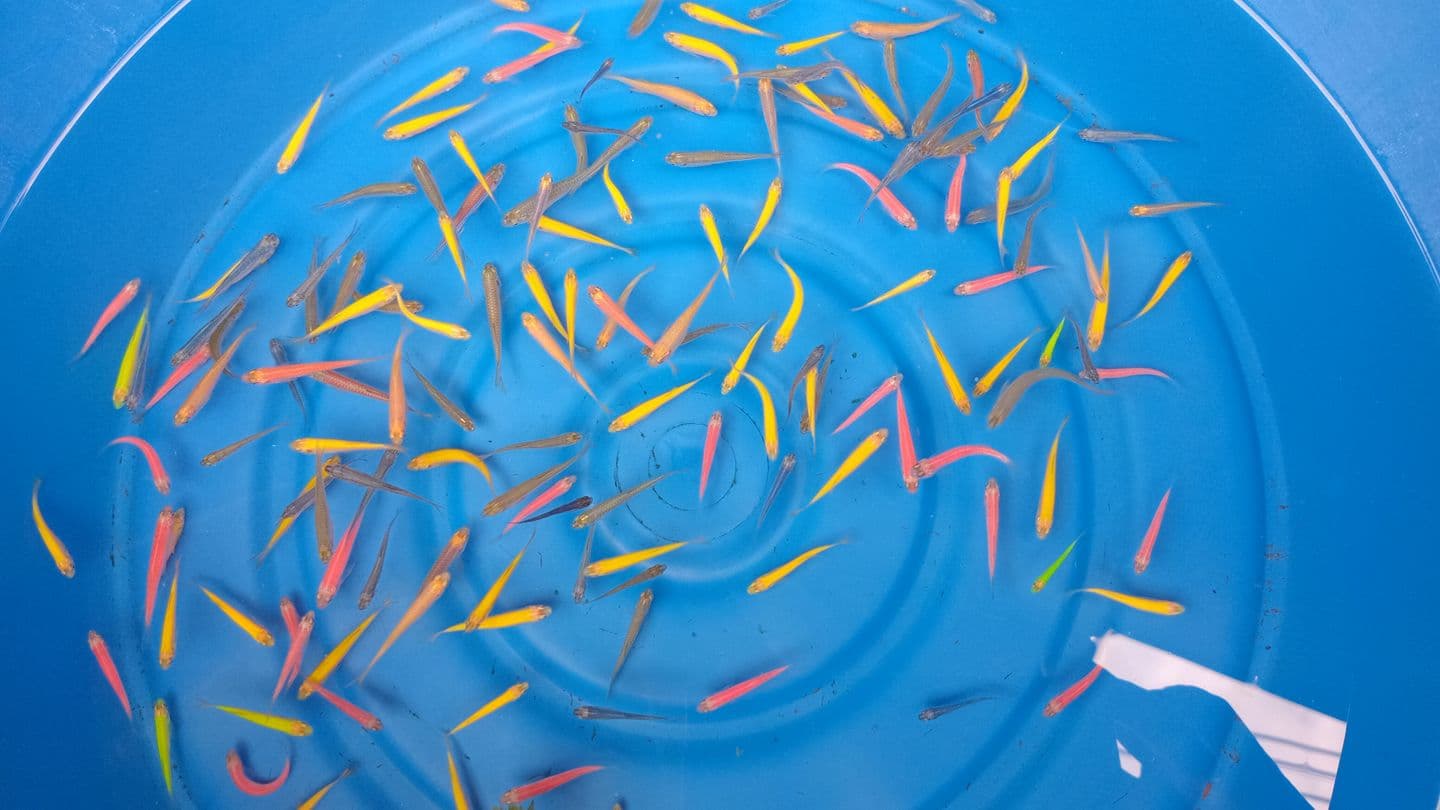
The giant danio, Devario aequipinnatus, lives up to its name, reaching ten to fifteen centimetres, considerably larger than the zebra or pearl danio and easily the biggest fish in this danio group. It
The giant danio, Devario aequipinnatus, lives up to its name, reaching ten to fifteen centimetres, considerably larger than the zebra or pearl danio and easily the biggest fish in this danio group. It is native to fast-flowing streams in the Western Ghats of India and parts of Sri Lanka, giving it genuine home-ground status for Indian aquarists.
Its body carries bold blue and gold-yellow horizontal stripes, and its size and speed make it a striking, active centrepiece fish rather than a background shoaler.
Tank and water requirements
Given its adult size and very active swimming style, a group of five or more giant danios needs a tank of at least a hundred and fifty litres, with plenty of length for the fast, continuous swimming this species is known for.
It is hardy and adaptable to a range of water conditions, including typical Indian tap water, but genuinely needs the swimming space, and is a poor fit for anything smaller than a fairly large community tank.
Diet and behaviour
An omnivorous diet of good-quality flakes or pellets, supplemented with occasional live or frozen food, suits its size and activity level. It is a fast, enthusiastic feeder that rarely struggles to find food even alongside more assertive tankmates.
Giant danios are peaceful but boisterous, and while they generally do not nip fins, their sheer speed and energy can stress slower, more timid fish sharing the tank, so mid-sized, similarly active tankmates work best.
Buying tips
Priced around thirty to seventy rupees per fish in most Indian shops that stock larger danios
Best suited to a spacious community tank rather than a small or nano setup
A genuinely Indian native species, worth mentioning to visitors as a fish that comes from the streams of the Western Ghats rather than from abroad
The scissortail rasbora, Rasbora trilineata, gets its name from the black-and-white banded tail fin, which opens and closes in a scissoring motion as the fish swims, a genuinely visible behaviour rath
Flushing a fish, whether dead or simply unwanted, down the toilet is a habit many Indian households have inherited without questioning it, and it carries real risks that are worth understanding.
A cover might seem like an afterthought compared to filtration or lighting, but for a saltwater tank it does real, unglamorous work: cutting evaporation, which matters a great deal given how salinity