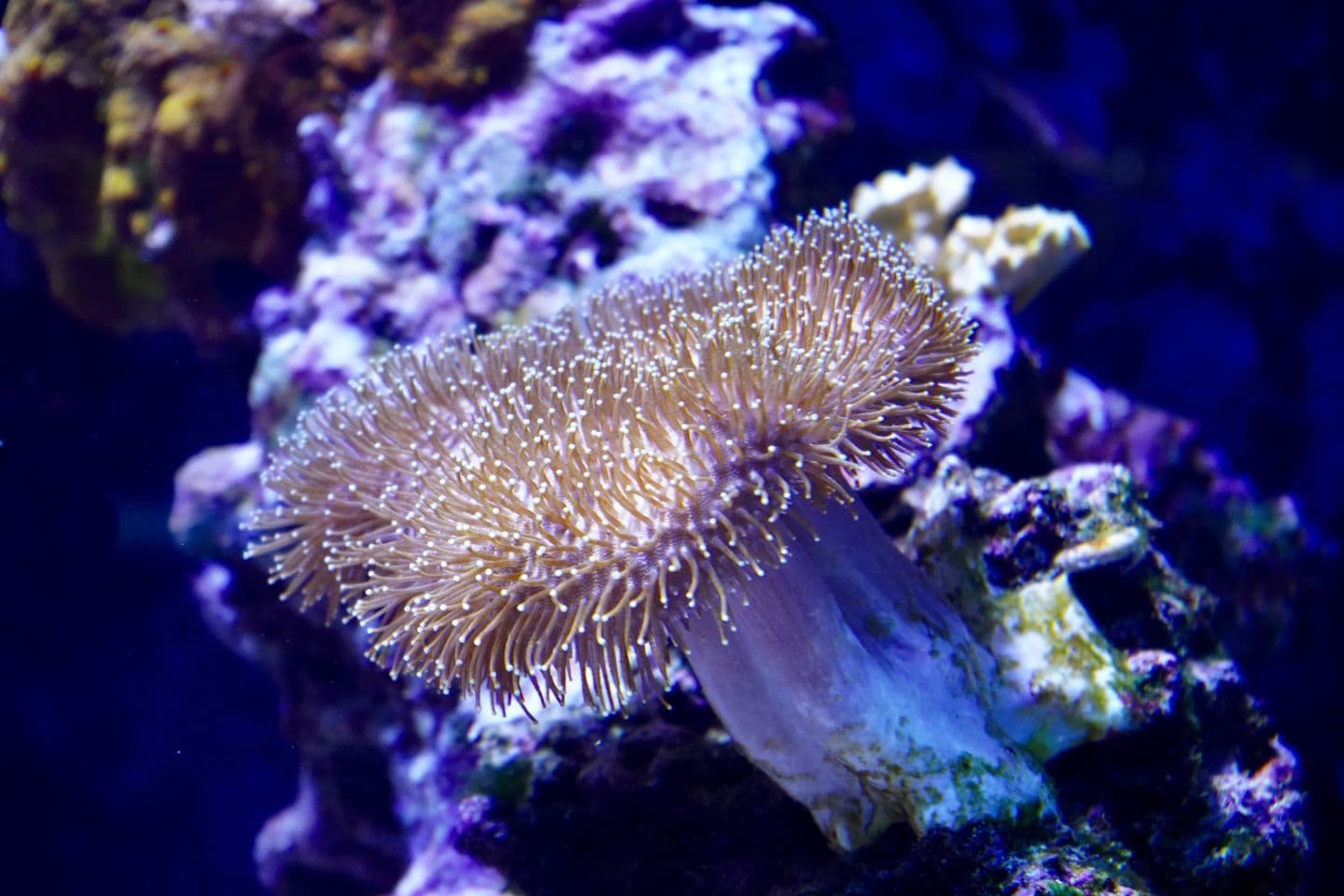
Duncan coral, known scientifically as Duncanopsammia axifuga, is one of the most forgiving large polyp stony corals available to reef keepers, which makes it a favourite starter LPS for hobbyists movi
Duncan coral, known scientifically as Duncanopsammia axifuga, is one of the most forgiving large polyp stony corals available to reef keepers, which makes it a favourite starter LPS for hobbyists moving on from soft corals. It is also sold under the names whisker coral, branched disc coral and daisy coral.
What it looks like
Duncan coral grows as a branching skeleton topped with fleshy, daisy like polyp heads that extend long, gently waving tentacles. Colours range from green and brown to purple and cream, often with a contrasting oral disc, and the tentacles glow noticeably under blue or actinic lighting.
Care requirements
Lighting: low to moderate, around 100 to 150 PAR. Duncans do not need to sit under the brightest part of the tank.
Flow: moderate and indirect. Strong direct flow can prevent the polyps from opening fully.
Placement: lower to middle rockwork rather than the highest points of the aquascape.
Temperament: peaceful, with no sweeper tentacles that sting neighbours, though a growing colony still needs room so it does not physically crowd nearby corals.
Water parameters: standard reef parameters suit it well, calcium 400 to 450 ppm, alkalinity 7 to 9 dKH, magnesium 1250 to 1350 ppm, temperature 24 to 27 degrees Celsius.
Feeding
Duncans get a share of their energy from the zooxanthellae algae living in their tissue, but they also actively catch food with their tentacles and benefit noticeably from direct feeding. Offering small meaty foods such as mysis shrimp, brine shrimp or a reef specific pellet two to three times a week tends to speed up growth and improve colour.
Growth and propagation
Duncan coral is a relatively fast grower for an LPS, often producing a new head every four to eight weeks under stable conditions and regular feeding. Established colonies can be fragged by carefully cutting through the branching skeleton between heads, making this a popular coral to trade or sell within the local reefing community.
Common problems
Polyps staying closed: usually points to flow that is too strong, lighting that is too intense, or a recent water parameter swing.
Receding tissue near the base: often linked to unstable alkalinity or calcium, or aggressive neighbouring corals growing too close.
Flatworms on the polyps: a common minor pest on Duncan coral; a short freshwater or iodine based coral dip before adding a new frag to the tank helps prevent an infestation.
Placement near other corals
Duncan coral itself does not sting, but that also means it has no defence if placed too close to more aggressive corals such as hammer, torch or frogspawn, which can sting and damage it with their own sweeper tentacles. Leave a gap of at least ten to fifteen centimetres between a Duncan colony and any known aggressive LPS neighbour, and remember that gap needs to grow along with the coral.
Availability in India
Duncan coral is imported rather than locally farmed, so availability depends on marine livestock shipments reaching Indian aquarium shops, and prices can vary noticeably between metro cities with regular importers and smaller towns. Given the import journey, it is worth quarantining a new Duncan frag for two to three weeks before adding it to a display tank, watching for the flatworms mentioned above.
The scissortail rasbora, Rasbora trilineata, gets its name from the black-and-white banded tail fin, which opens and closes in a scissoring motion as the fish swims, a genuinely visible behaviour rath
Flushing a fish, whether dead or simply unwanted, down the toilet is a habit many Indian households have inherited without questioning it, and it carries real risks that are worth understanding.
A cover might seem like an afterthought compared to filtration or lighting, but for a saltwater tank it does real, unglamorous work: cutting evaporation, which matters a great deal given how salinity