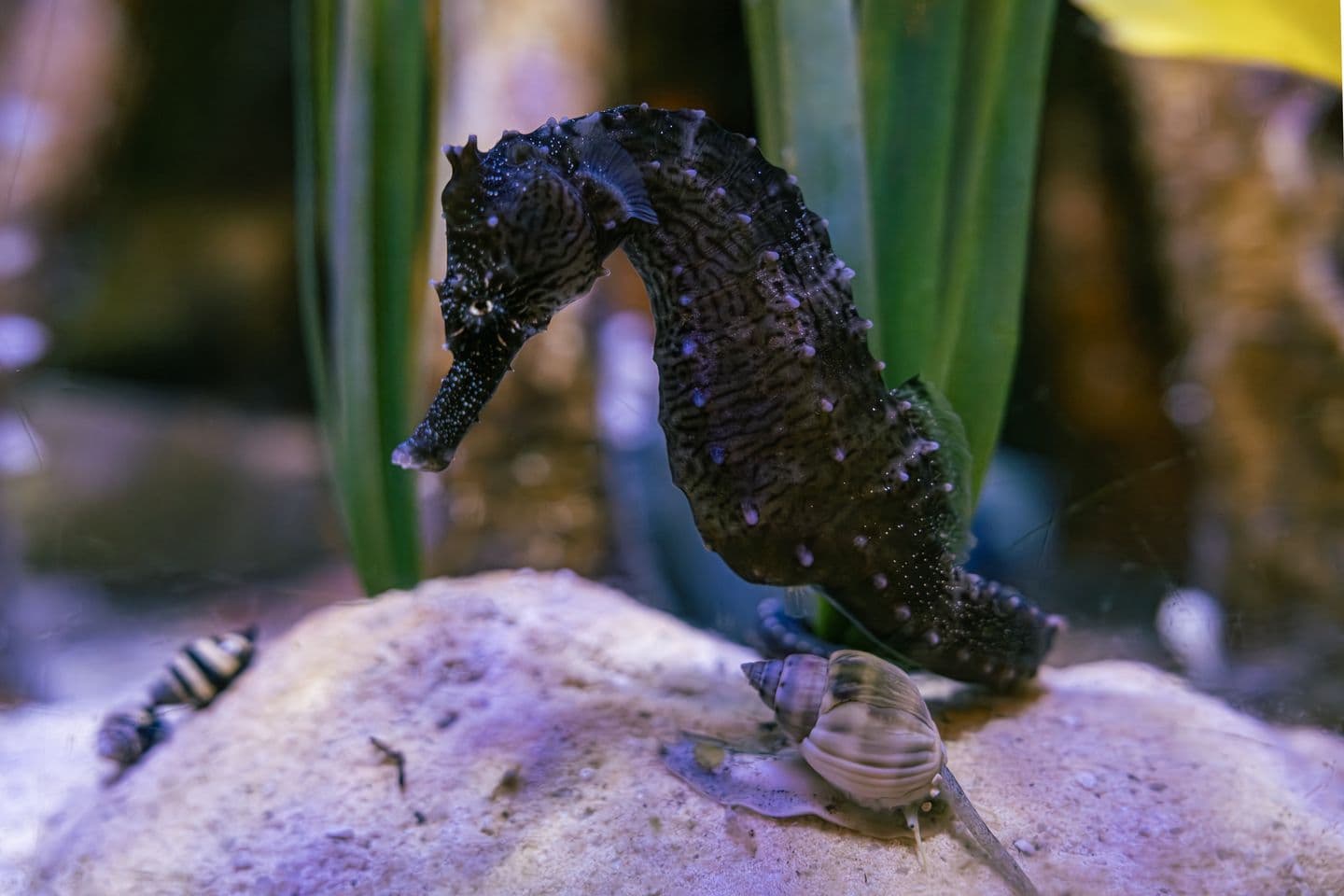
Seahorses are among the most captivating animals in the marine hobby, but they are also genuinely specialised, with needs different enough from typical reef fish that a seahorse tank is really its own
Seahorses are among the most captivating animals in the marine hobby, but they are also genuinely specialised, with needs different enough from typical reef fish that a seahorse tank is really its own category of fishkeeping rather than a variation on a standard marine setup. Anyone drawn to them is well served by understanding these differences clearly before committing.
Why seahorses need their own kind of tank
Seahorses are weak, slow swimmers that rely on anchoring their prehensile tails to plants, gorgonians, or décor rather than swimming freely against any real current. This means a seahorse tank needs notably gentle water flow, roughly 5 to 10 times the tank's volume per hour, considerably lower than the flow rate a typical reef tank runs, since strong current genuinely exhausts and stresses them.
Water parameters and setup
Seahorses do best at a slightly cooler temperature than many tropical reef fish, generally 23 to 26 degrees Celsius, with salinity around 1.021 to 1.025 and a stable pH of 8.1 to 8.4. Standard marine filtration works, but since seahorses are messy, frequent eaters, keeping up with mechanical filter cleaning every one to three days and staying disciplined about water changes matters more here than in a typical fish only tank.
Feeding is a genuine daily commitment
Seahorses have small stomachs and fast metabolisms, and need feeding two to three times daily, primarily on mysis shrimp, rather than the once or twice daily feeding most other marine fish are content with. Uneaten food should be removed promptly to protect water quality, and slower, target feeding is often necessary to make sure a seahorse actually gets enough, since they cannot compete well against faster tankmates at a shared feeding spot.
Choosing tank mates carefully
Seahorses do best in a species-only tank or alongside genuinely peaceful, slow-moving companions such as small gobies or pipefish. Avoid clownfish, damsels, tangs, and any fast or boisterous species, since even typically peaceful fish can out-compete a seahorse for food or nip at its delicate fins and snout. Keep seahorses themselves in pairs or small groups rather than alone, since they are naturally social, and choose same-sex pairs if you want to avoid an unplanned and genuinely prolific breeding population.
Sourcing seahorses responsibly
Captive-bred seahorses are considerably hardier and better adapted to aquarium life and prepared foods than wild-caught individuals, which struggle more with the transition and carry a higher disease risk. Seeking out a reputable captive-bred source, even if it costs more upfront, meaningfully improves the odds of long-term success and avoids contributing to wild population pressure on a genuinely vulnerable group of animals.
Why a seahorse tank is really its own commitment
It bears saying plainly: a seahorse tank is not a variation you add to an existing reef display, it is its own specialised setup with its own flow, feeding and tankmate rules that often conflict with what a typical reef tank needs. Anyone drawn to seahorses is better served planning a dedicated tank around their specific needs from day one, rather than trying to retrofit an existing colourful reef community to accommodate them, which rarely ends well for the seahorses.
The scissortail rasbora, Rasbora trilineata, gets its name from the black-and-white banded tail fin, which opens and closes in a scissoring motion as the fish swims, a genuinely visible behaviour rath
Flushing a fish, whether dead or simply unwanted, down the toilet is a habit many Indian households have inherited without questioning it, and it carries real risks that are worth understanding.
A cover might seem like an afterthought compared to filtration or lighting, but for a saltwater tank it does real, unglamorous work: cutting evaporation, which matters a great deal given how salinity