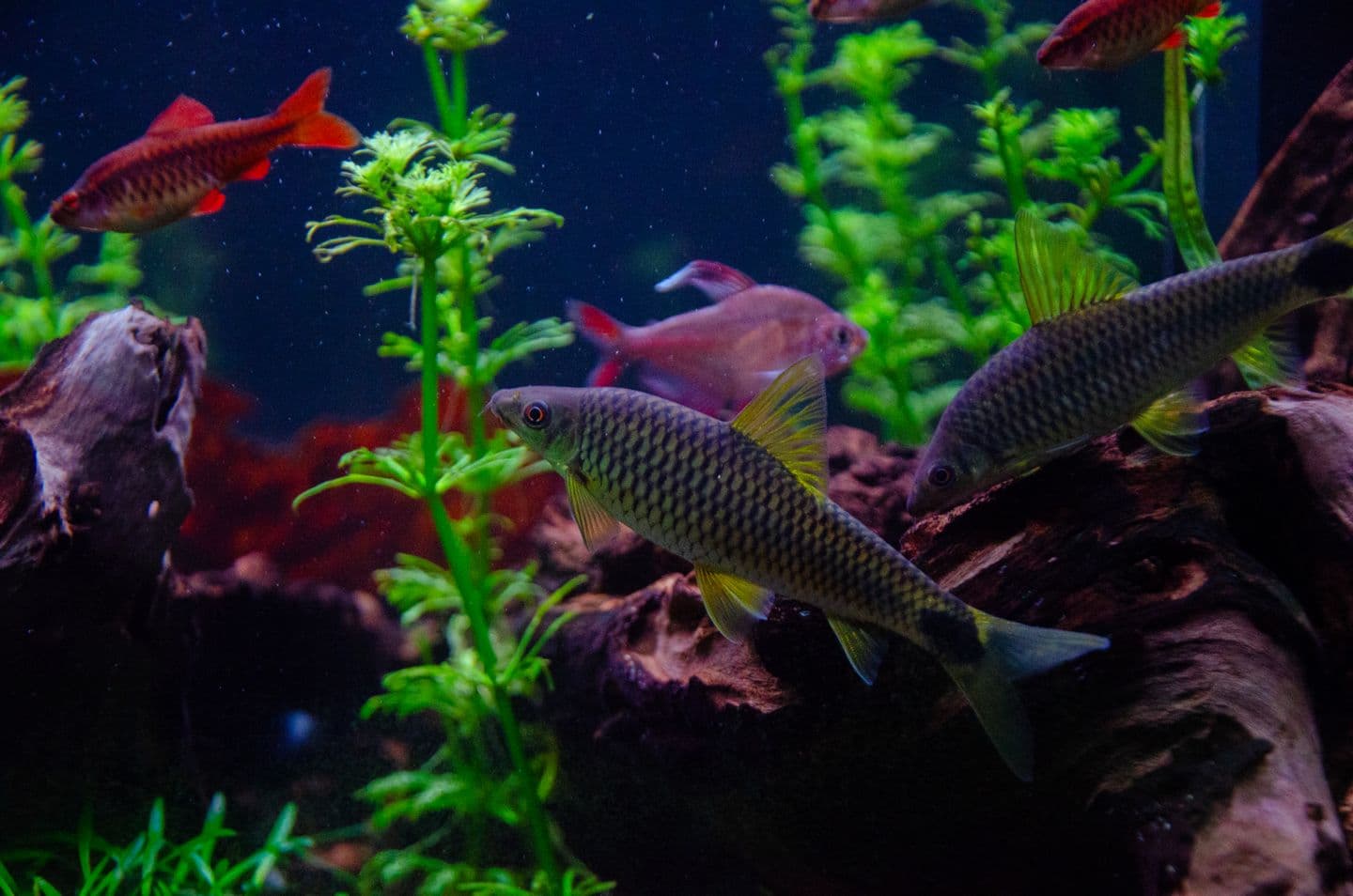
The leopard danio carries a striking pattern of dark spots over a golden body, quite different from the horizontal stripes of its close relative the zebra danio. For years it was thought to be a separ
The leopard danio carries a striking pattern of dark spots over a golden body, quite different from the horizontal stripes of its close relative the zebra danio. For years it was thought to be a separate species, but genetic studies have shown it is in fact a naturally occurring spotted colour form of Danio rerio, the same species as the common zebra danio, arising from a single gene mutation that changes stripes into spots.
This means it shares the zebra danio's native range across streams and rice paddies of eastern India, Nepal and Bangladesh, and behaves identically in the aquarium despite looking quite different.
Tank and water requirements
A group of six or more does well in a tank of sixty litres or more, with the same active, fast-swimming nature as the standard zebra danio. It shares the same hardiness and easily tolerates typical Indian tap water and a broad temperature range.
A secure lid matters here too, since leopard danios jump just as readily as their striped counterparts.
Diet and behaviour
An easy omnivorous diet of flakes, micro pellets and occasional live or frozen food suits it well. It is just as active and hardy as the zebra danio, making it equally suitable for a beginner's tank, including one still cycling.
It can be kept alongside standard zebra danios in the same shoal, since the two interbreed freely and behave identically, though most keepers prefer to keep the two patterns as separate, visually distinct groups.
Buying tips
Priced similarly to the standard zebra danio, generally fifteen to thirty rupees per fish
A good way to add pattern variety to a danio shoal without adding any extra care difficulty
Worth knowing it is a colour form rather than a distinct species if a shop or fellow hobbyist claims otherwise
The scissortail rasbora, Rasbora trilineata, gets its name from the black-and-white banded tail fin, which opens and closes in a scissoring motion as the fish swims, a genuinely visible behaviour rath
Flushing a fish, whether dead or simply unwanted, down the toilet is a habit many Indian households have inherited without questioning it, and it carries real risks that are worth understanding.
A cover might seem like an afterthought compared to filtration or lighting, but for a saltwater tank it does real, unglamorous work: cutting evaporation, which matters a great deal given how salinity