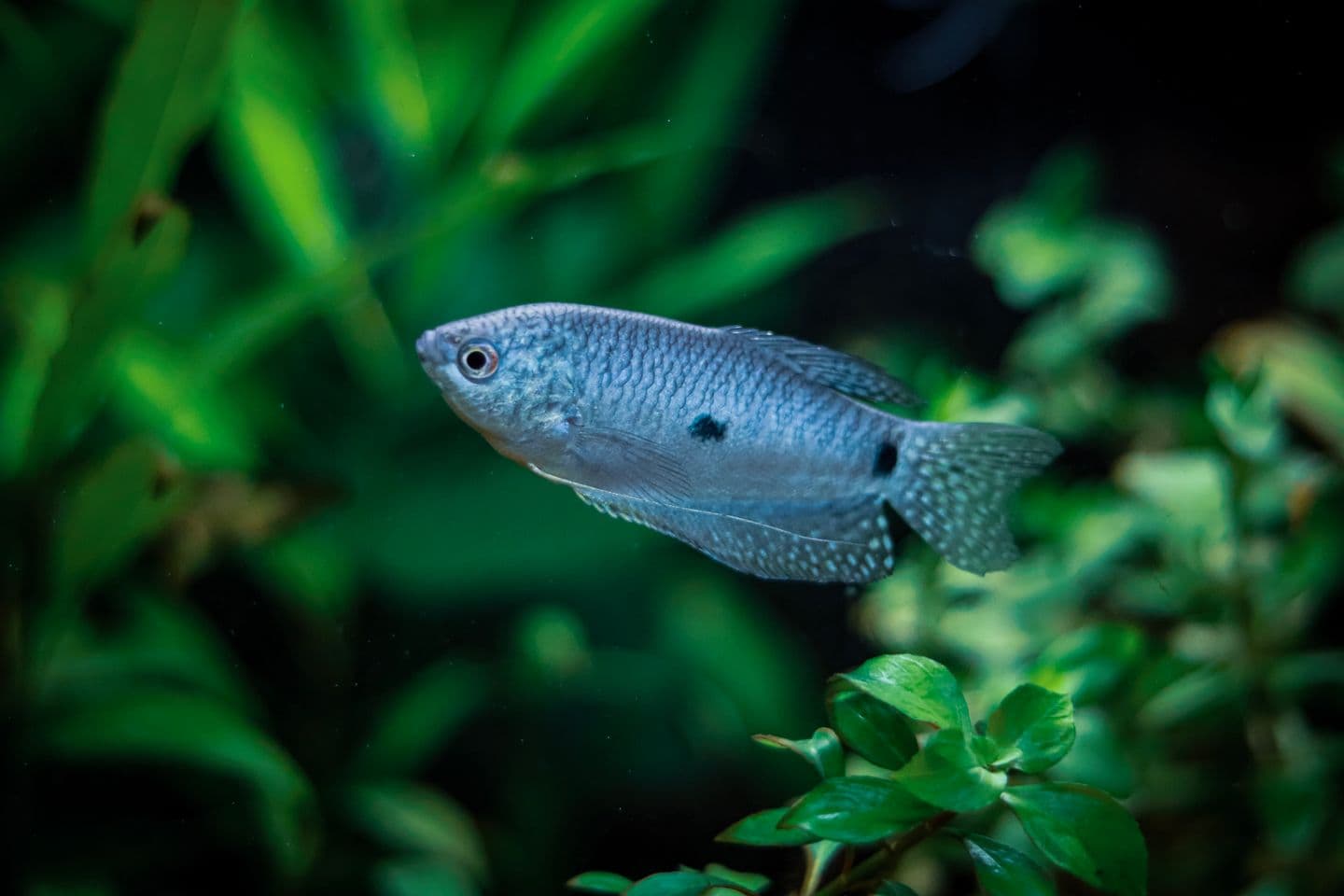
The pearl gourami carries a fine, lace-like pattern of white spots across a silvery brown body, giving it an appearance somewhere between mother-of-pearl and frost. A dark horizontal stripe runs from
The pearl gourami carries a fine, lace-like pattern of white spots across a silvery brown body, giving it an appearance somewhere between mother-of-pearl and frost. A dark horizontal stripe runs from the eye to the tail, and breeding males develop an orange throat and chest. It reaches around eleven to twelve centimetres, larger than the dwarf gourami.
It has a calmer, more graceful swimming style than many other gouramis and is well regarded as one of the more peaceful, community-friendly larger gouramis available.
Tank and water requirements
Given its size, a single pearl gourami or a calm pair needs a tank of at least a hundred litres, with floating plants and some quiet, planted areas it can retreat to. It adapts well to typical Indian tap water once settled.
As a labyrinth fish, it benefits from a lid with an air gap and a warm, humid layer near the water surface, and a tightly sealed, cold room can genuinely affect its breathing comfort over time.
Diet and behaviour
A varied diet of good-quality flakes or pellets, supplemented with occasional live or frozen food, suits it well. It is peaceful towards most tankmates, including smaller fish, though males can show some territoriality towards each other.
It mixes well with similarly calm mid to large community fish and rarely causes trouble in a well-planned tank.
Buying tips
Priced around one hundred to two hundred fifty rupees per fish in most Indian shops that stock larger gouramis
A good centrepiece fish for a peaceful, larger community tank rather than a small nano setup
Choose fish with a clear, undamaged pearl pattern and active swimming rather than clamped fins or listlessness
The scissortail rasbora, Rasbora trilineata, gets its name from the black-and-white banded tail fin, which opens and closes in a scissoring motion as the fish swims, a genuinely visible behaviour rath
Flushing a fish, whether dead or simply unwanted, down the toilet is a habit many Indian households have inherited without questioning it, and it carries real risks that are worth understanding.
A cover might seem like an afterthought compared to filtration or lighting, but for a saltwater tank it does real, unglamorous work: cutting evaporation, which matters a great deal given how salinity