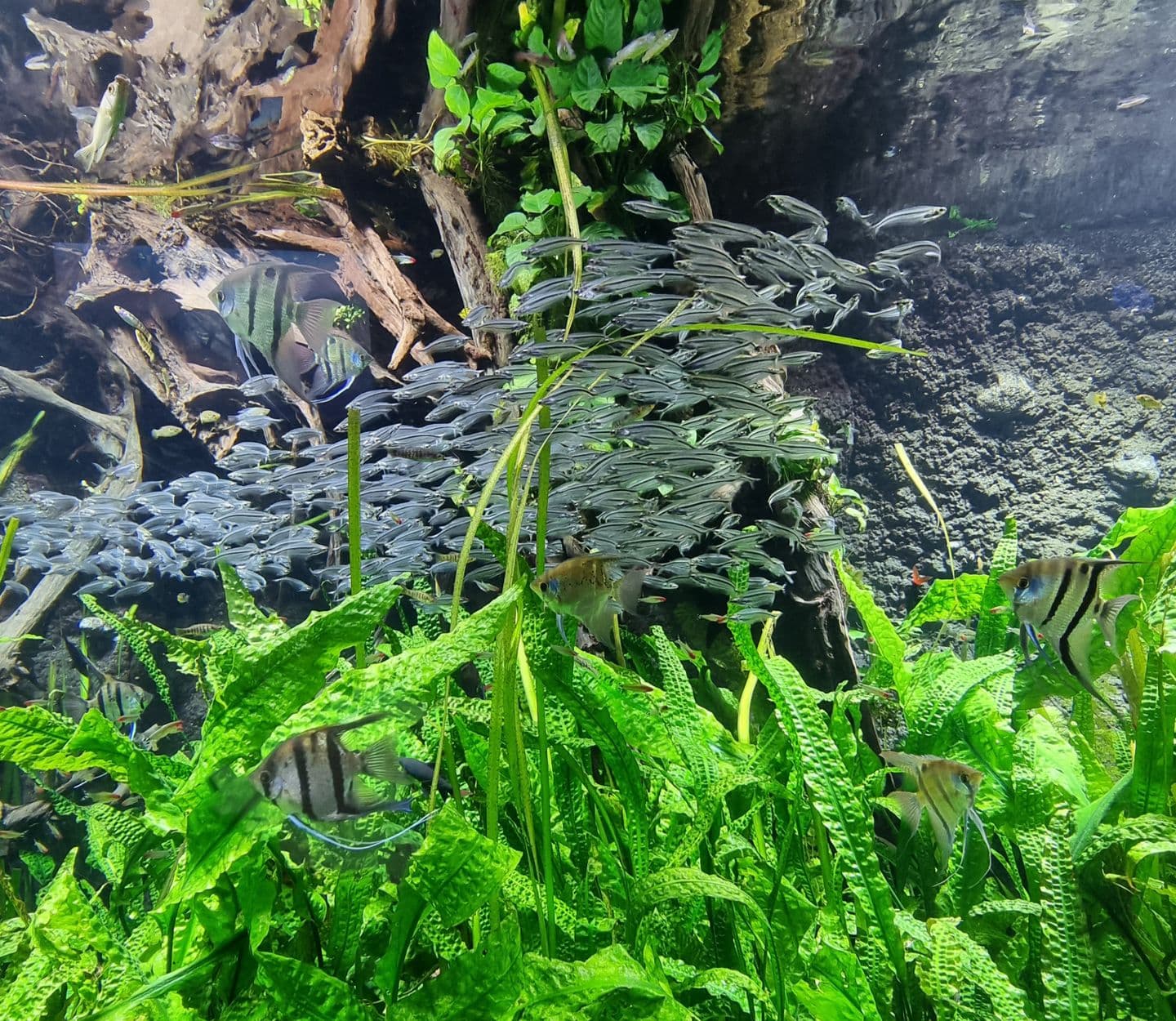
The pictus catfish has a silvery body covered in dark spots, long trailing whiskers and a genuinely active, inquisitive personality that sets it apart from the more sedentary corydoras and plecos on t
The pictus catfish has a silvery body covered in dark spots, long trailing whiskers and a genuinely active, inquisitive personality that sets it apart from the more sedentary corydoras and plecos on this list. It comes from South America and reaches around eleven to twelve centimetres.
It is considerably more predatory than its peaceful appearance suggests, and a pictus catfish will happily eat any tankmate small enough to fit in its mouth, a detail worth knowing before choosing companions for it.
Tank and water requirements
A group of three or more does well in a tank of a hundred litres or more, with open swimming space and some hiding spots such as caves or driftwood. It is hardy and tolerant of a range of water conditions, including typical Indian tap water.
It is mostly active at night and around dusk and dawn, so feeding at these times ensures it actually gets enough food in a busy, brightly lit community tank.
Diet and a tankmate warning
An omnivorous diet of sinking pellets, occasional live or frozen bloodworm and shrimp suits it well. It is not a fussy eater and will readily take whatever food is available.
Tankmates should be chosen with real care: small fish such as neon tetras, chili rasboras or other nano species are genuinely at risk from a pictus catfish once it reaches a reasonable size, while similarly sized or larger, robust community fish make far safer companions.
Buying tips
Priced around sixty to one hundred fifty rupees per fish in most Indian shops
Keep only with tankmates too large to be swallowed, given this species' genuine predatory streak towards small fish
Be cautious handling this fish during maintenance, since its spines can deliver a mildly painful jab if mishandled
The scissortail rasbora, Rasbora trilineata, gets its name from the black-and-white banded tail fin, which opens and closes in a scissoring motion as the fish swims, a genuinely visible behaviour rath
Flushing a fish, whether dead or simply unwanted, down the toilet is a habit many Indian households have inherited without questioning it, and it carries real risks that are worth understanding.
A cover might seem like an afterthought compared to filtration or lighting, but for a saltwater tank it does real, unglamorous work: cutting evaporation, which matters a great deal given how salinity