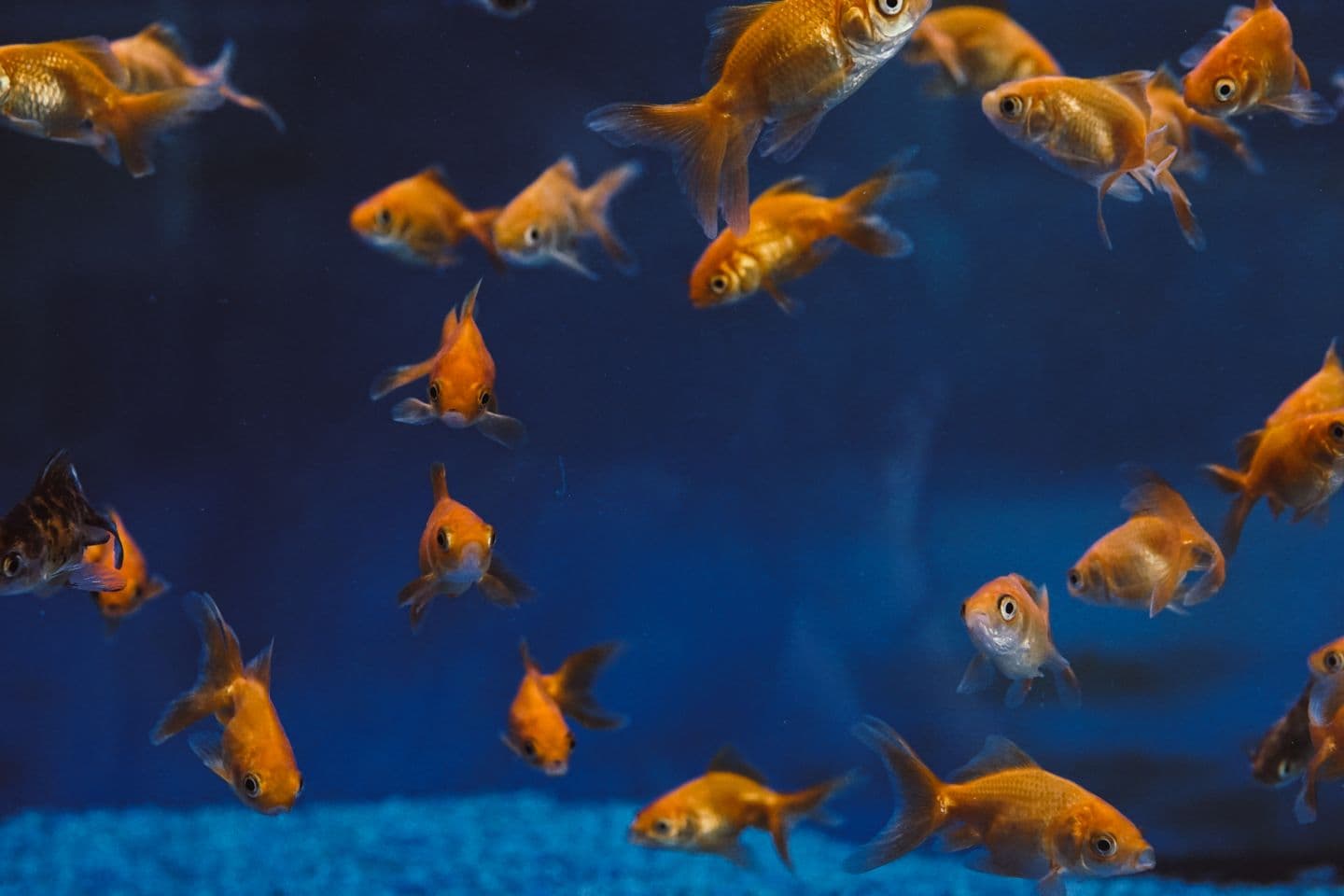
Bred in Japan from Chinese lionhead stock, the ranchu is often called the king of goldfish among serious fancy goldfish keepers. It shares the lionhead's dorsal-fin-less, egg-shaped body and raspberry
Bred in Japan from Chinese lionhead stock, the ranchu is often called the king of goldfish among serious fancy goldfish keepers. It shares the lionhead's dorsal-fin-less, egg-shaped body and raspberry-textured wen, but is distinguished by a more sharply arched back and a tail that tucks in at roughly a forty five degree angle rather than trailing flat.
Mature ranchus reach fifteen to twenty centimetres and are prized in competitive goldfish shows for the evenness of their wen and the smoothness of their back curve.
Tank requirements
Because it lacks a dorsal fin, the ranchu is not a strong or particularly agile swimmer, and needs calm tankmates that will not out-compete it for food. A single fish needs at least seventy five litres, kept free of sharp decor that could injure the wen.
Being coldwater fish, ranchus need no heater in Indian conditions and, like other fancy goldfish, do best on the cooler side of the tropical range.
Diet and care
A diet of sinking pellets, blanched peas and greens, with occasional protein such as bloodworm, supports both body condition and wen development, which can take a year or more to fully form.
Because the wen can obscure the eyes as it grows, watch that a heavily developed ranchu is still finding food, and separate it from faster tankmates if it seems to be losing out at feeding time.
Buying tips
Priced higher than most other fancy goldfish in India, often two hundred to six hundred rupees for young fish and considerably more for show-quality specimens
Ask specifically for ranchu rather than lionhead, since Indian shops often use the two names loosely for similar-looking fish
A curved back and downward-angled tail, rather than a flatter back, is the clearest tell of a true ranchu
The scissortail rasbora, Rasbora trilineata, gets its name from the black-and-white banded tail fin, which opens and closes in a scissoring motion as the fish swims, a genuinely visible behaviour rath
Flushing a fish, whether dead or simply unwanted, down the toilet is a habit many Indian households have inherited without questioning it, and it carries real risks that are worth understanding.
A cover might seem like an afterthought compared to filtration or lighting, but for a saltwater tank it does real, unglamorous work: cutting evaporation, which matters a great deal given how salinity