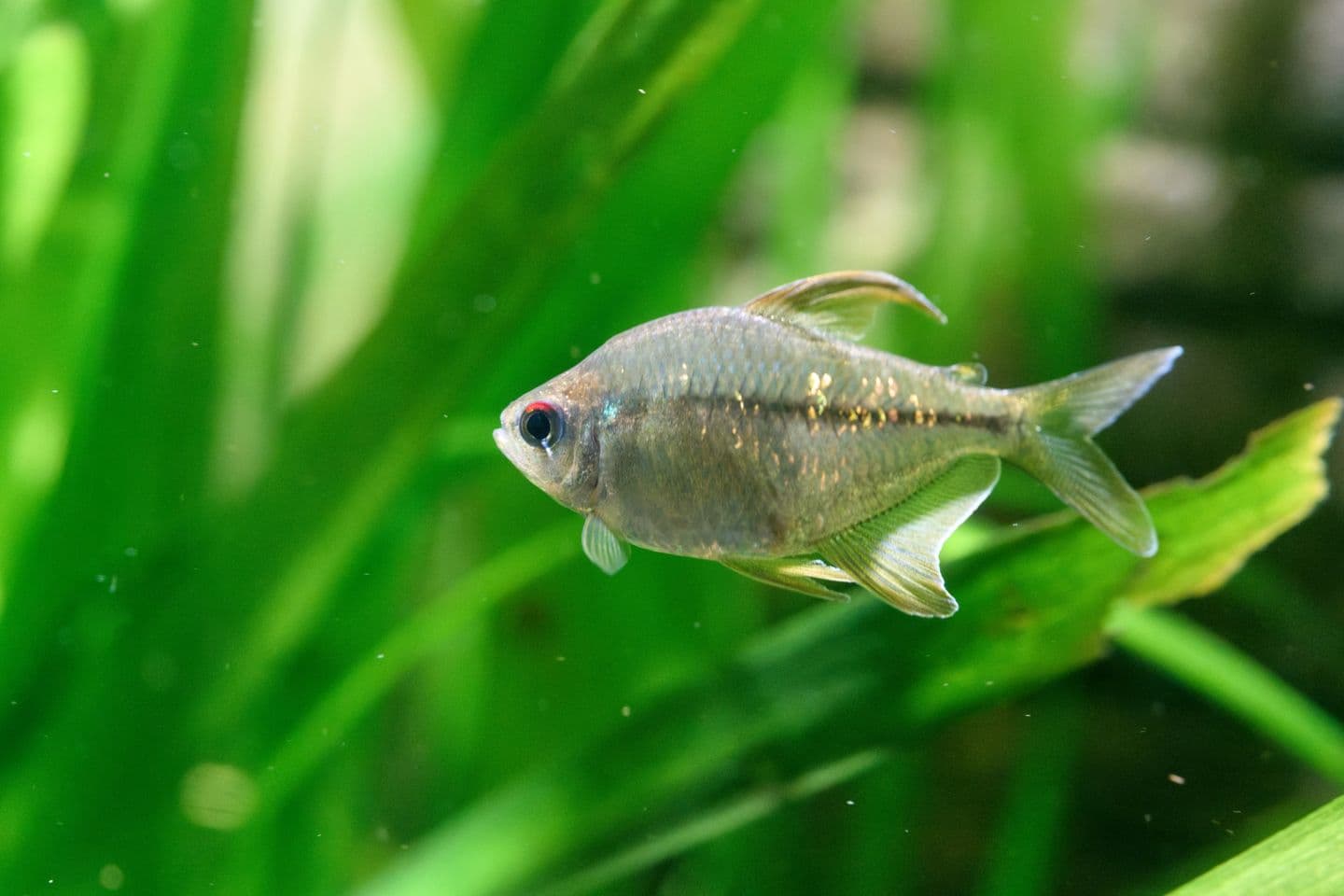
The rummy nose tetra, most commonly the species Hemigrammus bleheri sold in the trade, is instantly recognisable by its bright red head and a tail striped in black and white. It comes from the Amazon
The rummy nose tetra, most commonly the species Hemigrammus bleheri sold in the trade, is instantly recognisable by its bright red head and a tail striped in black and white. It comes from the Amazon and Orinoco basins and reaches around four to five centimetres.
What sets it apart from almost every other aquarium fish is that its colour genuinely reflects real-time water conditions. A deep, vivid red across the whole head signals a healthy fish in clean, stable water, while a pale or pink nose is an early warning of stress, poor water quality or illness, often showing up before a test kit would catch the problem.
Tank and water requirements
Rummy nose tetras are true tight schoolers rather than loose shoalers, and look their best in a group of twelve or more in a long tank of at least ninety centimetres. A tank of a hundred litres or more suits a proper school comfortably.
They need a mature, well-established tank with stable water rather than a newly set up one, since they are notably sensitive to ammonia, nitrite and sudden parameter swings. This makes them a poor choice for a brand new aquarium, however appealing they look in the shop.
Diet and a practical note
A varied diet of small flakes, micro pellets and occasional live or frozen food suits them well. Their colour naturally fades to a duller shade at night while resting, which is normal, but a nose that stays pale through the day is worth investigating with a water test.
Because of this sensitivity to water quality, many experienced Indian aquarists deliberately add a school of rummy nose tetras to more delicate community tanks, using them as an early warning system for problems before more sensitive or expensive fish are affected.
Buying tips
Priced around thirty to seventy rupees per fish, higher than basic neons given their more demanding care
Not recommended for a newly set up tank, however good they look in the shop, since an uncycled tank will fade their colour and stress the fish quickly
Buy the full group at once rather than adding a few at a time, since a proper school schools far more tightly and confidently
A naming note
Three closely related, near-identical species are all sold as rummy nose tetra: the true rummy nose Hemigrammus rhodostomus, the common rummy nose Hemigrammus bleheri, which is the one most widely bred and sold, and the so-called false rummy nose Petitella georgiae. Telling them apart reliably needs a close look at the tail striping, and in practice even most shops do not distinguish between them, so the name on the tank label is not a guarantee of exact species.
The scissortail rasbora, Rasbora trilineata, gets its name from the black-and-white banded tail fin, which opens and closes in a scissoring motion as the fish swims, a genuinely visible behaviour rath
Flushing a fish, whether dead or simply unwanted, down the toilet is a habit many Indian households have inherited without questioning it, and it carries real risks that are worth understanding.
A cover might seem like an afterthought compared to filtration or lighting, but for a saltwater tank it does real, unglamorous work: cutting evaporation, which matters a great deal given how salinity