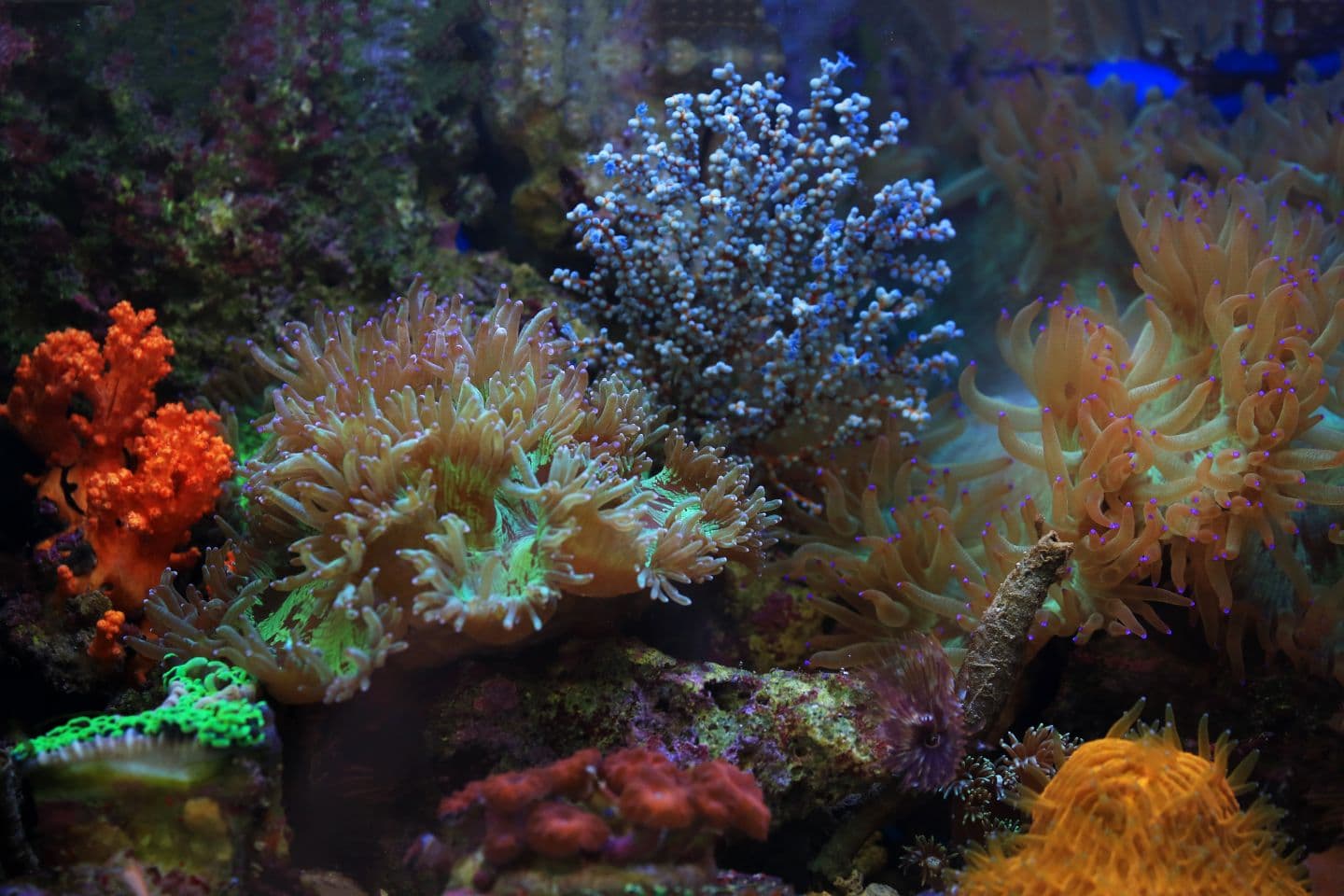
What a Genuinely Thriving Marine Aquarium Looks Like
Most advice in this series, understandably, focuses on spotting problems. It's worth stepping back and describing the opposite: what a healthy, well-run marine tank actually looks like day to day, sin
Most advice in this series, understandably, focuses on spotting problems. It's worth stepping back and describing the opposite: what a healthy, well-run marine tank actually looks like day to day, since knowing the baseline makes it much easier to notice when something has quietly started to slip.
Signs the whole system is working, not just the fish
Coralline algae spreading steadily across rock and the back glass, a visible sign that calcium, alkalinity and lighting are all in a workable range
Fish with fully extended fins, active grazing or hunting behaviour, and colours that look saturated rather than washed out
A clean-up crew (snails, hermit crabs, certain small fish) that's visibly busy rather than hiding constantly
Minimal nuisance algae on the glass between cleanings, suggesting nutrients are being exported as fast as they're produced
Fish that come out to feed promptly and confidently rather than hesitating or hiding at feeding time
The quieter, easy to miss indicators
A thriving tank also tends to develop small, unplanned life on its own, tiny feather duster worms appearing on the glass, pods visible on the rock at night with a flashlight, the odd baby snail. This kind of incidental biodiversity is a genuinely good sign; it means the tank's ecosystem is stable enough to support life beyond what was deliberately stocked, not just tolerating it.
The health benefit that goes both ways
Research from marine biologists and psychologists, including a well-known study out of Plymouth's National Marine Aquarium, has found that watching a well-stocked aquarium measurably lowers blood pressure and heart rate in people, with the effect growing stronger as the number of fish in view increases. A thriving marine tank isn't just healthier for what's inside it, it does something real for the person watching it too, which is a fair return on the effort a reef tank demands.
Using this as a checklist
None of these signs need to be perfect all the time, reef tanks have slow weeks and algae blips like any living system. But a tank that's been missing most of these signs for a stretch of weeks, rather than days, is usually telling you something is drifting even if no single water test has flagged it yet.
The scissortail rasbora, Rasbora trilineata, gets its name from the black-and-white banded tail fin, which opens and closes in a scissoring motion as the fish swims, a genuinely visible behaviour rath
Flushing a fish, whether dead or simply unwanted, down the toilet is a habit many Indian households have inherited without questioning it, and it carries real risks that are worth understanding.
A cover might seem like an afterthought compared to filtration or lighting, but for a saltwater tank it does real, unglamorous work: cutting evaporation, which matters a great deal given how salinity