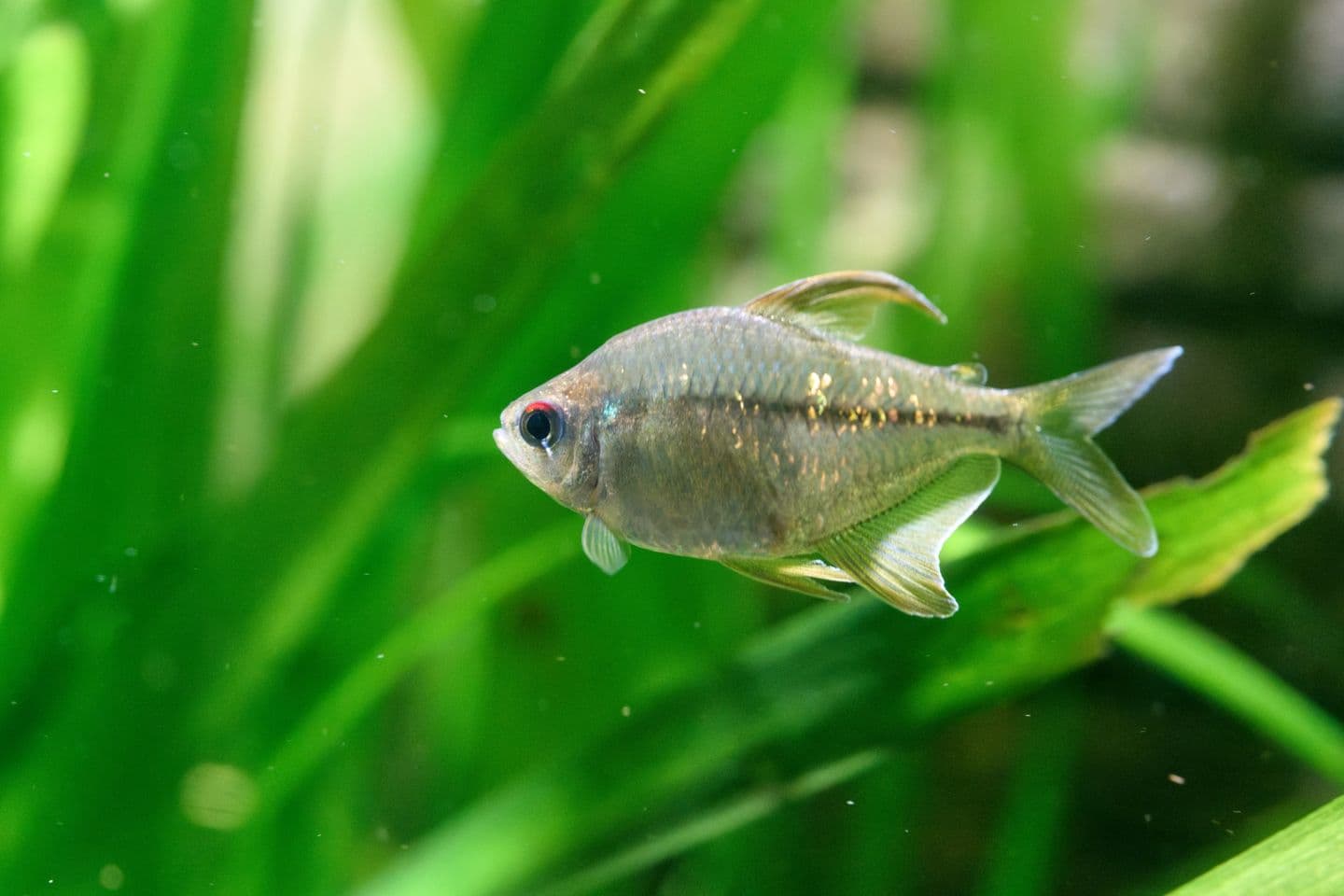
The cardinal tetra, Paracheirodon axelrodi, is often mistaken for the neon tetra at a glance, but the two are easy to tell apart once you know what to look for. On a cardinal, the red stripe runs the
The cardinal tetra, Paracheirodon axelrodi, is often mistaken for the neon tetra at a glance, but the two are easy to tell apart once you know what to look for. On a cardinal, the red stripe runs the full length of the body from behind the eye to the tail, while on a neon it only covers the back half.
Cardinals are also slightly larger, reaching four to five centimetres, and carry a deeper, more saturated blue stripe that many aquascapers consider the more striking of the two fish.
Tank and water requirements
Cardinals need the same shoaling numbers as neons, ideally ten or more in a tank of forty litres upwards, but are noticeably fussier about water quality. They come from the blackwater of the Rio Negro basin, where the water is very soft and acidic, and do less well than neons when kept in harder, more alkaline water, which is common straight out of the tap in many parts of India.
A planted tank with driftwood, which naturally softens and acidifies water over time, along with reverse osmosis or rainwater blending where tap water is particularly hard, gives cardinals the best chance of thriving long term.
Diet and behaviour
A varied diet of small flakes, micro pellets and occasional live or frozen food suits cardinals well. They are peaceful, active shoalers that look their best in a planted tank with subdued lighting, which shows off their colour without stressing them.
Because they are more demanding than neons, cardinals are better suited to a hobbyist with some existing experience rather than a first tank.
Buying tips
More expensive than neon tetras in India, typically thirty to eighty rupees per fish
Worth the extra cost for a planted or aquascaped tank where the fuller red stripe shows to best effect
Ask about the water the shop keeps them in, since cardinals shipped straight from harder water into a soft-water home tank, or the reverse, often struggle to settle
The scissortail rasbora, Rasbora trilineata, gets its name from the black-and-white banded tail fin, which opens and closes in a scissoring motion as the fish swims, a genuinely visible behaviour rath
Flushing a fish, whether dead or simply unwanted, down the toilet is a habit many Indian households have inherited without questioning it, and it carries real risks that are worth understanding.
A cover might seem like an afterthought compared to filtration or lighting, but for a saltwater tank it does real, unglamorous work: cutting evaporation, which matters a great deal given how salinity