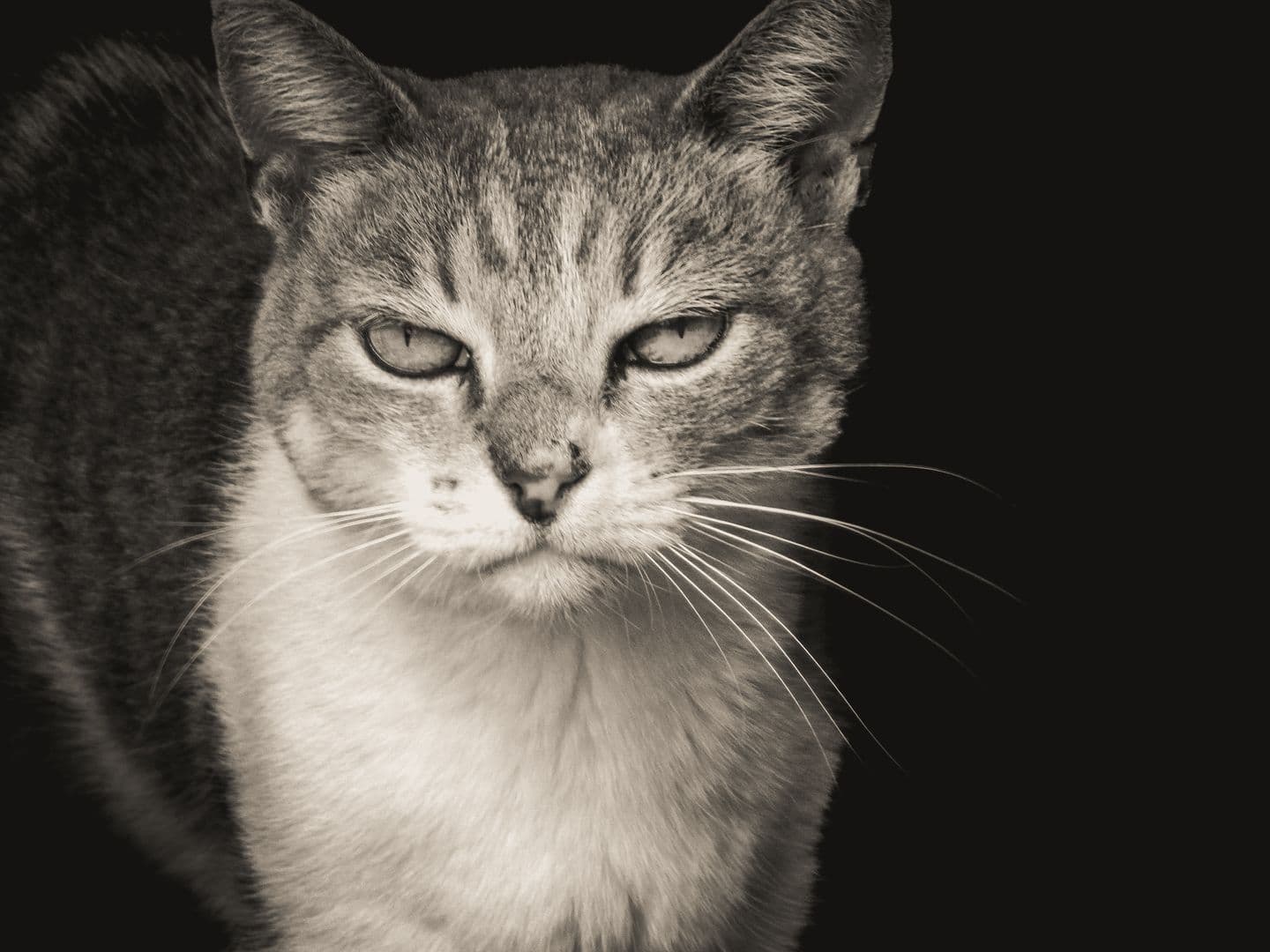
Watching a cat react to its own reflection raises a genuinely interesting question about feline self-awareness, and the honest answer is more nuanced than a simple yes or no.
Watching a cat react to its own reflection raises a genuinely interesting question about feline self-awareness, and the honest answer is more nuanced than a simple yes or no.
Cats encountering a mirror for the first time often react with curiosity or mild caution, sometimes peering behind the mirror as though searching for the other cat they can see. Whether this means a cat understands the reflection as itself, rather than as a separate cat, has actually been studied, using the same basic test developed for assessing self-awareness in other species.
The mirror test, explained
Developed by psychologist Gordon Gallup in 1970, the mirror self-recognition test involves placing an odourless mark somewhere on an animal's body that it cannot normally see without a mirror, then observing whether the animal investigates or tries to remove the mark once it notices it in its reflection. Passing this test is generally taken as evidence of a certain kind of self-awareness, and it has been passed by species including chimpanzees, dolphins, and elephants.
What happens when cats are tested
Cats have not been shown to reliably pass the mirror test. When marked and shown their reflection, cats generally do not investigate the mark on their own body, and most lose interest in a mirror fairly quickly after an initial period of curiosity or mild wariness, treating the reflection as an unfamiliar cat that behaves oddly rather than as themselves.
Why this does not necessarily mean much about feline intelligence
The mirror test was designed around vision, which is not the primary sense cats use to build a sense of identity or to recognise other individuals. Cats identify each other largely through scent, and a mirror offers no scent information at all, which may make the test a poor fit for how a cat's mind actually processes identity, rather than genuine proof of an absence of self-awareness. Several researchers have made this same point about other animals that rely more heavily on senses besides vision, since failing a vision based test does not automatically mean an animal lacks a sense of self, only that the test was not built with that animal's dominant senses in mind.
The honest scientific position is that cats do not pass the classic mirror test, but that this leaves the deeper question of feline self-awareness genuinely open rather than settled, since the tool used to measure it may simply not be the right one for a species that experiences the world through smell as much as, or more than, sight.
A scent-based alternative some researchers propose
Researchers studying dogs, another species that relies heavily on smell, have experimented with a scent-based version of the self-recognition test, sometimes called the sniff test of self-recognition, which looks at whether an animal spends less time investigating its own scent compared with an altered or unfamiliar one, the same underlying logic as the mirror test but built around the sense the animal actually relies on. A similar scent-based approach has not yet been formally applied to cats in published research, but it represents a promising direction for testing self-awareness in a way that plays to a cat's actual strengths rather than a sense, vision, that plays a smaller role in how it understands the world.
Almost every calico cat you meet, with that distinctive patchwork of orange, black and white, will be female. This is not folklore, it comes down to genetics, and it is one of the more elegant example
A swollen eye looks alarming, and it should get your attention quickly. The eyelid, the eyeball itself, or the tissue around the eye can all swell for very different reasons, so working out which one
Most cats never need their claws trimmed at all, and clipping can even work against them, since cats rely on their claws for both defence and climbing. As cats age and become less mobile, though, claw