Cats have a rich communication system that owners often underestimate. To understand a cat properly, it helps to know how much information passes between cats, and between cats and people, through pos
Cats have a rich communication system that owners often underestimate. To understand a cat properly, it helps to know how much information passes between cats, and between cats and people, through posture, touch, scent and sound. Interestingly, direct eye contact between cats tends to signal a challenge, which may partly explain why cats often gravitate toward the one person in a room who is paying them the least attention.
Visual signals
Cats have relatively flat, immobile faces compared with dogs, so posture and specific body parts carry much of the message. Tail position is one of the clearest signals: a tail held straight up, perpendicular to the ground, with pricked ears and relaxed whiskers, signals a friendly approach. A tail held out and swishing slowly can indicate aggression, and in extreme cases the tail may puff up along its length, along with a raised strip of fur along the spine, to make the cat look bigger. A tail tucked between the back legs usually signals nervousness or submission.
Ears and eyes matter too. Ears held erect and rotated outward, paired with narrow pupils, generally signal anger, while dilated pupils and flattened ears usually signal fear. A relaxed cat holds its ears forward in a neutral position. An arched back can mean a defensive stance, while a crouching, cringing posture with the tail thumping is classically defensive. A stretched-out body can indicate confidence, or in some cases a readiness to attack.
Eye contact itself carries meaning: an unblinking stare is a challenge, while relaxed blinking or half-closed eyes signal contentment and non-threat. Whiskers fan forward when a cat is alert or tense, sit more relaxed when the cat is calm, and flatten back against the face when the cat is frightened.
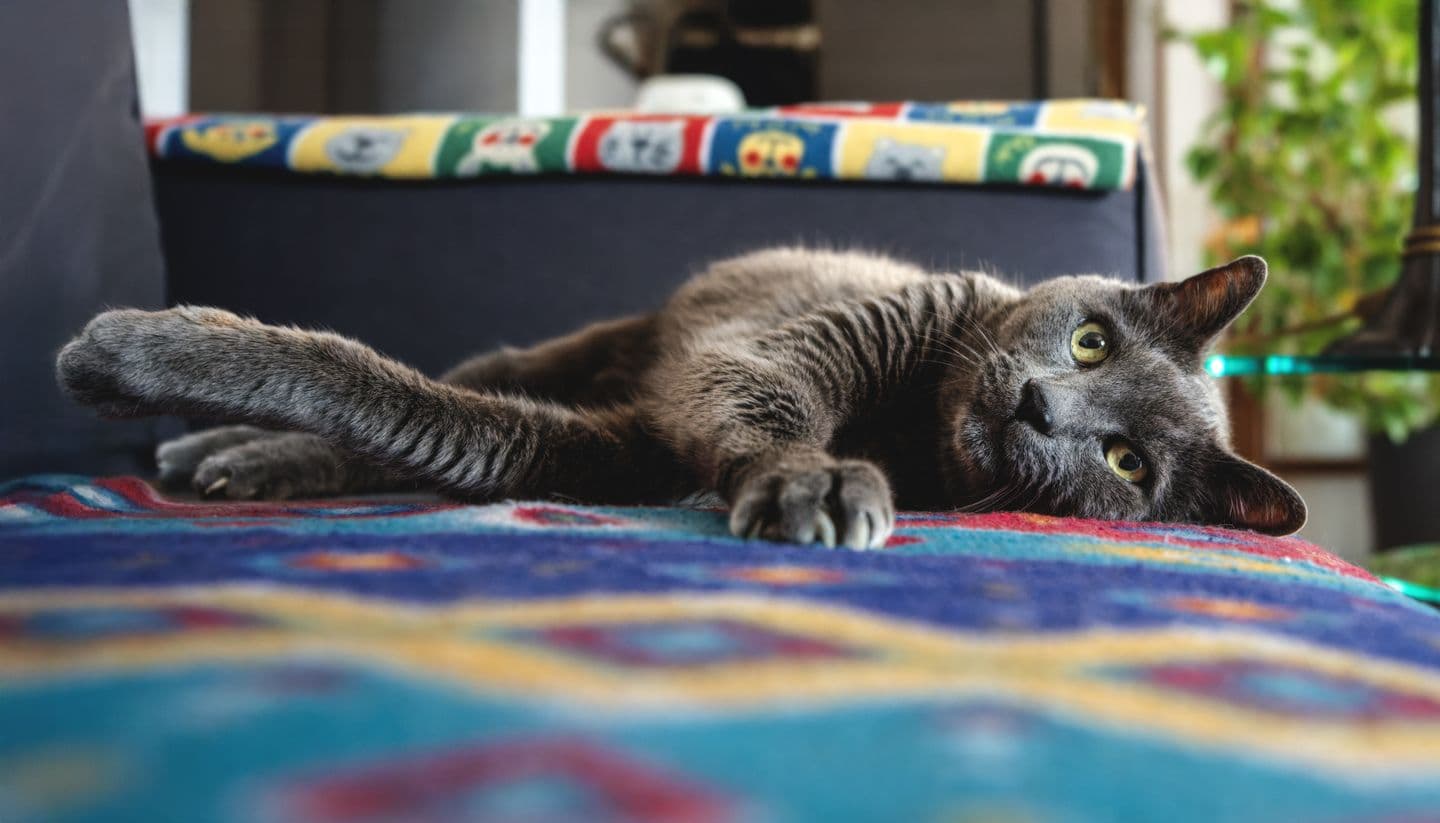
Some visual signals remain only partly understood, including scratching (which may double as a territorial visual marker along well-used routes rather than at territory boundaries) and rolling onto the back to expose the belly, thought to be a friendly or submissive gesture.
Touch
Cats communicate through touch as well: rubbing against each other (particularly around the face), mutual grooming, nose touching, and resting or curling up together, sometimes intertwining tails. This is thought to reinforce social bonds, though the finer details remain hard to interpret. Mutual grooming, which tends to focus on the head and neck, may sometimes help defuse tension between cats trying to avoid open conflict, and it occurs mostly between cats that are related or already familiar with each other. Touch and scent communication overlap, since scent is exchanged during physical contact.
Vocal communication
Cats are said to have one of the widest vocal ranges of any carnivore, likely useful in low-light conditions where visual signals are less effective. Vocalisations broadly fall into three categories.
Murmuring sounds, made with the mouth closed, used for greeting and approval — this includes purring, which begins in kittenhood as a sign of contentment during nursing and later becomes a greeting and care-soliciting call, alongside the friendly 'trill' or 'chirrup' greeting sound. Purring occurs at 25 to 150 vibrations per second, and while all cats in the Felidae family can purr, only the smaller cats (the Felis group) purr continuously; the big roaring cats like lions and tigers can only purr while exhaling.
Miaowing or vowel sounds, an extensive repertoire used mainly for friendly interactions, ranging from the high-pitched calls of hungry kittens to short, sharp miaows of adult displeasure.
Aggressive sounds, made with the mouth open, including growls, yowls, snarls, hisses, spits, shrieks and wails, used in both offensive and defensive confrontations.
Scent communication
Smell is arguably the most important channel of all for cats, given how developed their sense of smell is. Scent marks territory, identifies friendly individuals within a colony, and signals sexual receptiveness, among other likely functions that remain poorly understood by humans.
Cats typically bury faeces deep within their territory but may leave it uncovered near the boundary, which may help mark territorial limits. Urine spraying on vertical surfaces, seen more often in males than females, also plays a territorial and signalling role. Two unusual amino acids in cat urine, felinine and isovalthene, are largely responsible for the odour of tom-cat urine; unneutered males can excrete up to 95mg of felinine daily, roughly five times what females produce.
Scent glands in the skin, particularly under the chin, around the mouth and cheeks, on the forehead, and along the tail and its base, allow cats to exchange scent by rubbing against each other or against objects, a behaviour known as bunting. This seems to happen most in the core of a cat's territory and is linked to comfort and friendly interaction. Female rub-marks appear to carry information about reproductive cycle and receptivity.
Sebaceous glands between the toes mean scratching also leaves a scent mark alongside its visual one, typically along well-travelled routes through the territory rather than at its edges.
Because domestic cats have changed relatively little from their wild ancestor, Felis sylvestris lybica, over a small number of generations, their basic signalling repertoire is thought to closely resemble that of their wild relative, even if domestic cats have adapted some of these signals to suit a more socially dense lifestyle.
Almost every calico cat you meet, with that distinctive patchwork of orange, black and white, will be female. This is not folklore, it comes down to genetics, and it is one of the more elegant example
A swollen eye looks alarming, and it should get your attention quickly. The eyelid, the eyeball itself, or the tissue around the eye can all swell for very different reasons, so working out which one
Most cats never need their claws trimmed at all, and clipping can even work against them, since cats rely on their claws for both defence and climbing. As cats age and become less mobile, though, claw