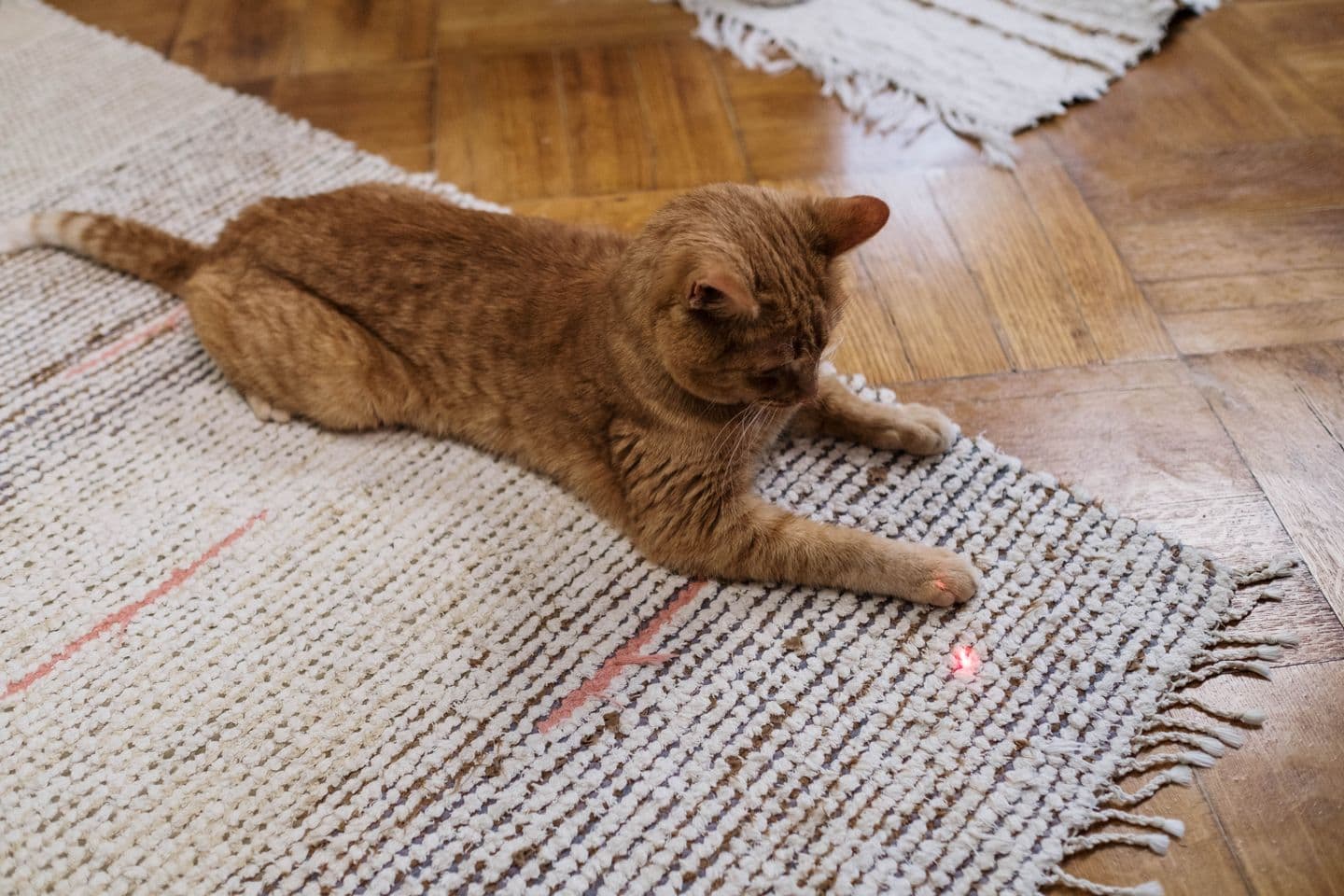
Most cats genuinely enjoy interacting with their owners, and play is one of the best ways to strengthen that bond. For a kitten, play isn’t optional, it’s a core part of healthy development. Most adul
Most cats genuinely enjoy interacting with their owners, and play is one of the best ways to strengthen that bond. For a kitten, play isn’t optional, it’s a core part of healthy development. Most adult cats continue to find it enjoyable too, and even as mobility and energy decline with age, gentler games can still bring pleasure to both cat and owner.
How involved an owner gets can range from a casual game of ball to structured, clicker-based training sessions built up over months, largely dependent on the individual cat’s nature and how much time the owner wants to invest.
Cats that never go outside particularly need regular stimulation, especially when young, to avoid boredom. Owners of indoor cats carry a real responsibility to meet both physical and mental needs. A cat with outdoor access, by contrast, finds plenty to occupy it naturally, walls and trees to climb, prey to stalk, leaves to chase, and sometimes other cats for company.
Every cat differs in how motivated it is to play, but virtually all cats will play, and benefit from doing so, given the right opportunity, regardless of age. Getting to know your own cat’s specific likes and dislikes is the key to offering the best possible play experiences, and how receptive it is at any given moment often ties into its natural rhythms and routines.
Signs that suggest a good moment for play include:
Spontaneous play with objects
Sudden, jerky movements
Dilated pupils and ears flattened sideways, with no other cat nearby
Frozen postures or crouched legs
A sudden burst of frantic activity (the so-called “mad half hour”)
Vocalisation
A cat with high play motivation typically:
Plays often and spontaneously with objects
Is receptive to play at almost any time
Isn’t fussy about which objects it plays with
Rarely tires first
Can be quite destructive, tearing or even eating toys
Responds to cues linked with play, such as the sound of a toy drawer opening
A cat with low play motivation typically:
Doesn’t initiate play with objects on its own
Is only receptive at particular times or in particular circumstances
Is selective about which toys it engages with
Tires quickly and needs real encouragement to start
Games worth trying
Toys can appeal to every feline sense, sight, sound, scent, touch and taste. Movement is a powerful draw, and most toys rely on some form of active motion. A gentle noise, such as a bell tucked securely inside a ball, often attracts attention, though louder or harsher sounds can alarm some cats. Catnip, whether rubbed onto a plastic toy or hidden inside a stuffed one, is especially valuable for blind cats and appeals to most cats generally. Some toys use varied fabrics that encourage clawing or neck-rubbing.
What any individual cat prefers usually comes down to some mix of texture, shape, size, scent, sound, type of movement (random, quick, stop-start), the presence or absence of owner involvement, time of day, location, and whether other cats are around.
Working out what appeals to your cat is largely trial and error, though certain toys tend to have broad appeal: those containing good-quality dried catnip, fishing-rod toys with feathers, small objects on wire that move unpredictably, and small fur mice. Even something as basic as a ping pong ball can provide hours of entertainment, light enough to cause no damage, and just the right size for a paw to bat around. On a staircase, tossing the ball up or dropping it from the top so it bounces step by step can spark real enthusiasm. Everyday household items, scrunched-up paper, sweet wrappers, string, corks, can become perfectly good toys too.
Types of play
Cats engage in several distinct kinds of play: solitary play such as simply running about; solitary object play with toys; social play with other cats, chasing and mock fighting; social play with humans, fetch, wand toys, laser pointers; and exploratory play involving cardboard boxes, activity centres, cupboards and bags.
Play tends to mirror the full predatory sequence, searching, stalking, chasing, pouncing, catching and manipulating, though it isn’t yet clear how much the order or completeness of that sequence actually matters. Some games, laser pointers being a classic example, can cause frustration when the pounce-and-catch stage never actually happens. Until more is understood, it’s sensible to follow the natural sequence as closely as possible, playing in short bursts before mealtimes and ending on a positive note when the cat successfully “catches” something.
Ground rules for play
If your cat has strong play motivation, you may find one particular toy reliably triggers enthusiasm every time. Use it sparingly to keep that power intact. Cats are naturally drawn to novelty, so toys left out permanently quickly lose their appeal. Rotating toys and storing them in a sealed bag between uses helps maintain interest.
End games on a positive note before your cat loses interest, and give a clear signal that play has stopped. If a cat becomes overexcited or overstimulated by a particular toy, stop and redirect its attention elsewhere. Interactive toys requiring your involvement shouldn’t be left lying around.
Short, frequent bursts of play that mimic natural hunting patterns tend to work best.
Playing with kittens
Kittens need to learn good manners early, discouraging scratching, clawing and biting while they’re small, before claws and teeth grow into genuine “weapons” capable of real damage or pain. Children, in particular, can be frightened by a cat that hasn’t learned restraint. Small feathers or toys on the end of a rod, wire or string help keep your hands safely out of range.
Play in older cats
Older cats shouldn’t be overlooked, even elderly cats benefit from gentle stimulation suited to their mobility. A game played lying down still offers real physical and mental benefit.
Multi-cat households
Play becomes more complicated where several cats live together, especially if one is far more motivated than the others, or if underlying tension exists within the group. A cat under social stress tends to avoid play altogether in favour of vigilance. It’s worth monitoring each cat individually in a multi-cat household and setting aside time for some one-on-one play.
Encouraging cats to play together
Cats are more likely to play with each other in an environment that supports it safely, ideally one with obstacles and varied heights offering cover, hiding spots and elevated places to retreat to. Being able to break eye contact during play fighting seems to help diffuse tension before it escalates into something more serious. Indoor play areas benefit from cardboard boxes with entry and exit points, furniture at varying heights, tables, and activity centres, positioned so each cat can approach and move around them from any direction.
When to step in
Occasionally it becomes necessary to intervene when play between cats escalates toward real risk of injury. Physically separating cats with your hands or legs is not advisable, in a heightened state, cats won’t distinguish you from each other and injury becomes likely. If things haven’t reached physical fighting but have progressed to a direct stare-down, breaking that visual contact is often enough to defuse things. A fishing-rod toy, laser pointer directed toward a favourite toy, or a large kick toy can help redirect attention by triggering peripheral vision through rapid movement.
If matters have gone further, a blanket or towel thrown over the cats can interrupt physical contact. Persistent problems warrant a vet’s advice, who may refer you to an animal behaviourist for a proper long-term assessment.
Almost every calico cat you meet, with that distinctive patchwork of orange, black and white, will be female. This is not folklore, it comes down to genetics, and it is one of the more elegant example
A swollen eye looks alarming, and it should get your attention quickly. The eyelid, the eyeball itself, or the tissue around the eye can all swell for very different reasons, so working out which one
Most cats never need their claws trimmed at all, and clipping can even work against them, since cats rely on their claws for both defence and climbing. As cats age and become less mobile, though, claw