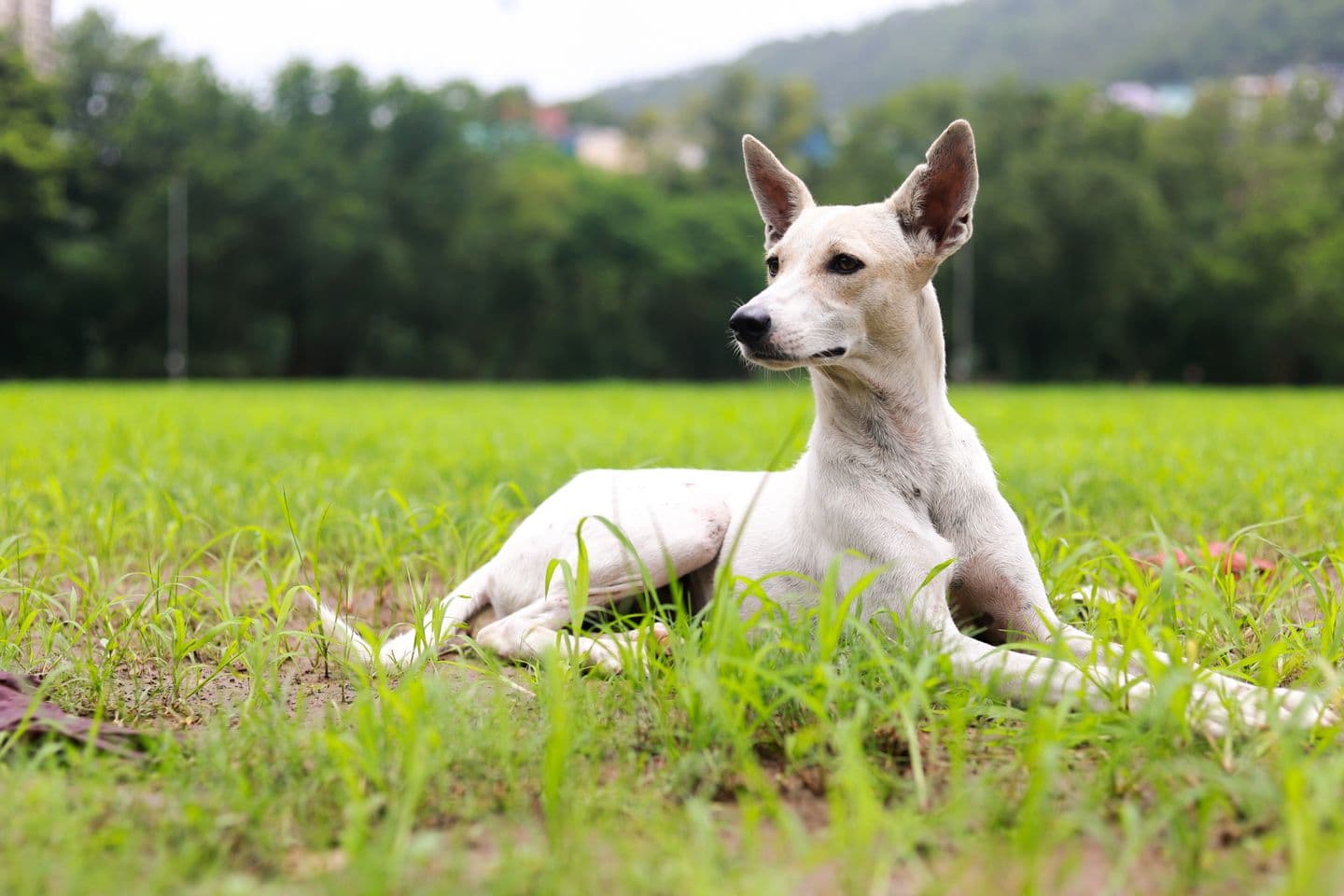
Other names: Desi Kutta, INDog, South Asian Pye Dog, Indie Dog | Native to: Found throughout the Indian subcontinent
Quick facts
A landrace breed believed to have lived alongside people in India for over 4,000 years
Recognised by the Kennel Club of India, with erect ears, a wedge shaped head and a curved tail
Naturally healthy and disease resistant, the product of thousands of years of natural selection
Genetic studies link the breed to the ancestry of the Australian dingo
The story
Long before any formal breed standard existed, the Indian pariah dog had already worked out how to survive and thrive across every kind of Indian landscape, from crowded city lanes to open farmland. This is arguably India's original dog, shaped almost entirely by natural selection rather than deliberate human breeding, which is precisely why it is so remarkably hardy.
The name pariah was, ironically, popularised by the British, partly as a way to make imported European breeds seem more desirable by comparison. In truth, this is one of the oldest domesticated dog lineages anywhere in the world, with genetic studies suggesting a connection to the Australian dingo, likely carried there by Indian seafarers thousands of years ago.
In temperament, the Indian pariah dog is alert, intelligent and deeply loyal, with a strong protective instinct that makes it a capable watchdog. It is also energetic and curious, doing best with an active household rather than as a passive companion. Because it has not been bred for exaggerated physical traits, it tends to avoid many of the hereditary health problems that affect heavily standardised breeds.
Build and appearance
The Indian pariah dog has a square or slightly rectangular build, a wedge shaped head with a pointed muzzle, and almond shaped, dark brown eyes that give it a keen, watchful expression. Its ears are erect and pointed, its coat is short and double layered with a thick outer coat over a softer undercoat, and its tail curls upward and rises further when the dog is alert or excited. Most adults weigh between 20 and 30 kg and stand 20 to 25 inches at the shoulder, with a lean, athletic frame built for endurance rather than bulk.
Colouring most often runs to solid fawn or a pied fawn and white pattern, with solid black considerably rarer. Archaeological evidence, including a skull found at the Mohenjo-Daro site dating back roughly 4,500 years, points to just how long this basic body type has remained essentially unchanged, a testament to how well suited it already was to Indian conditions from the start.
Where things stand today
Health wise, the Indian pariah dog is considered one of the most robust breeds anywhere, a natural result of thousands of years of unmanaged, competitive breeding rather than the closed studbook selection that produces many hereditary conditions in pedigree dogs. It typically lives 13 to 16 years, needs comparatively little specialised veterinary care, and copes with Indian heat and monsoon conditions far better than most imported breeds.
There is a growing and welcome movement across Indian cities to recognise the pariah dog's qualities and to encourage its adoption rather than overlooking it in favour of imported breeds. For families wanting a hardy, intelligent and genuinely Indian companion, the Indian pariah dog remains one of the country's best kept secrets, hiding in plain sight on every street, and choosing to adopt one also plays a small but meaningful part in addressing India's street dog population.
Beyond the familiar Great Dane and Saint Bernard, a number of large, calm breeds carry the same gentle-giant temperament without quite the same name recognition. Most remain genuinely rare in India, b
A once-bouncy dog that suddenly seems flat, uninterested in walks, and withdrawn from the family is unsettling to watch, and the question that naturally follows is whether dogs can actually feel somet
A healthy dog isn't just a contented one; they're more playful, more energetic and more emotionally settled. As their owner, you're the biggest factor in how well your dog thrives, day in and day out.