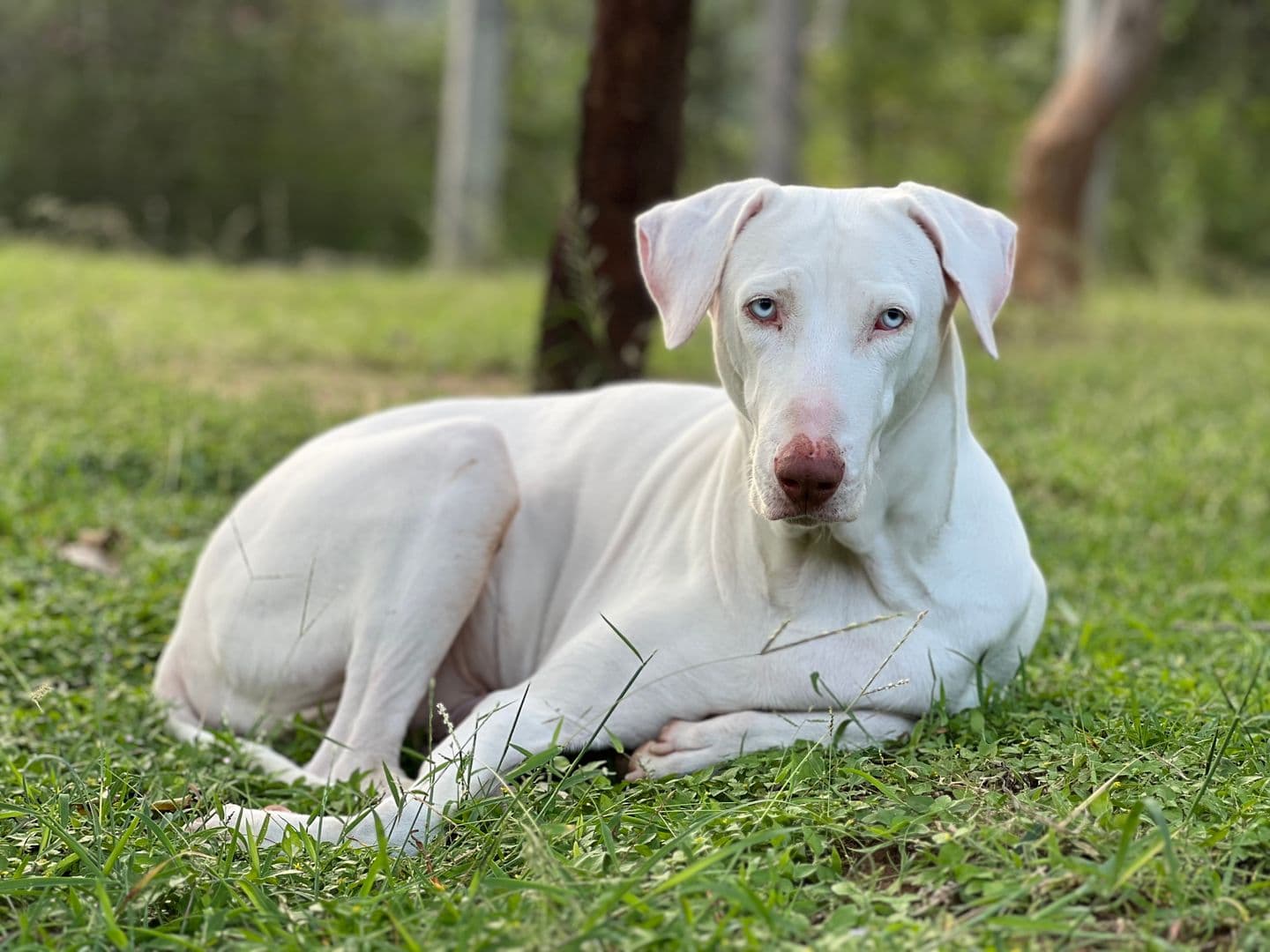
Other names: Polygar Hound, Indian Ghost Hound | Native to: Rajapalayam, Virudhunagar district, Tamil Nadu
Quick facts
A tall, elegant sighthound recognised by the Kennel Club of India, historically bred by the Nayak dynasty
Most prized in pure white with a pink nose and golden eyes, though other colours occur
Featured on an Indian postage stamp issued in 2005 alongside the Himalayan Sheepdog, Rampur Hound and Mudhol Hound
Used historically as a war dog during the Polygar Wars and the Carnatic Wars
The story
Named after its home town in Tamil Nadu's Virudhunagar district, the Rajapalayam is often described as one of India's most elegant native breeds, prized historically by the Nayak dynasty and later by the aristocracy of southern India. Its striking pure white coat and pink nose gave rise to its evocative nickname, the Indian Ghost Hound.
Its history is not purely decorative. During the Polygar Wars and the Carnatic Wars, Rajapalayam Hounds were pressed into service as war dogs, trained to attack enemy cavalry horses and to guard estates and fields against intruders. One enduring local legend tells of four Rajapalayams fighting off a tiger to protect their master, a story that has become part of the breed's folklore.
The Rajapalayam's build reflects its dual purpose as both hunter and guardian, with a somewhat larger head and powerful jaws suited to tackling wild boar, alongside the lean, long legged frame typical of a sighthound. It is intensely loyal to its family and territory, wary of strangers, and needs an experienced hand with training given its independent, protective nature.
Build and appearance
The Rajapalayam's facial structure is distinct among Indian sighthounds, with a slightly larger head and powerful jaws, adaptations that suited it to confronting wild boar rather than only coursing smaller game. The most prized colouring is pure white with faint brown markings, a pink nose and striking golden eyes, though black, brown and spotted variations have also been recorded within the breed. Some researchers have even speculated, without firm evidence, that the Rajapalayam may have contributed to the ancestry of the modern Dalmatian, a theory that remains disputed but adds to the breed's mystique.
Its frame combines the lean, long legged build typical of a sighthound with noticeably more substance through the head and jaw than breeds like the Chippiparai or Kanni, a visible reminder that this dog was built to fight as well as to run.
Where things stand today
The Rajapalayam typically lives up to around 12 years and is considered a hardy, low maintenance breed by pedigree standards, requiring little more than regular exercise and early socialisation to manage its naturally protective, somewhat aloof temperament around strangers.
The breed was formally recognised by ICAR-NBAGR as one of India's earliest indigenous dog breeds, alongside Chippiparai and Mudhol, a status that has helped conservation efforts in Tamil Nadu, and it has also drawn interest from the Indian Army as a native breed worth preserving and training. Even so, the Rajapalayam remains far less common than its history and recognition would suggest, and dedicated breeders in the region continue working to keep the line pure and healthy.
Beyond the familiar Great Dane and Saint Bernard, a number of large, calm breeds carry the same gentle-giant temperament without quite the same name recognition. Most remain genuinely rare in India, b
A once-bouncy dog that suddenly seems flat, uninterested in walks, and withdrawn from the family is unsettling to watch, and the question that naturally follows is whether dogs can actually feel somet
A healthy dog isn't just a contented one; they're more playful, more energetic and more emotionally settled. As their owner, you're the biggest factor in how well your dog thrives, day in and day out.