
Birds / Getting Started
Can Cats and Birds Live Together Safely?
It is possible in many Indian households, but it takes real management, not just hoping for the best.
3 min read
Birds / Getting Started
A bird in a small cage is a familiar sight in many households. A colourful budgerigar, a pair of finches or a talking parrot may be considered an attractive addition to a home. The cage is often treat
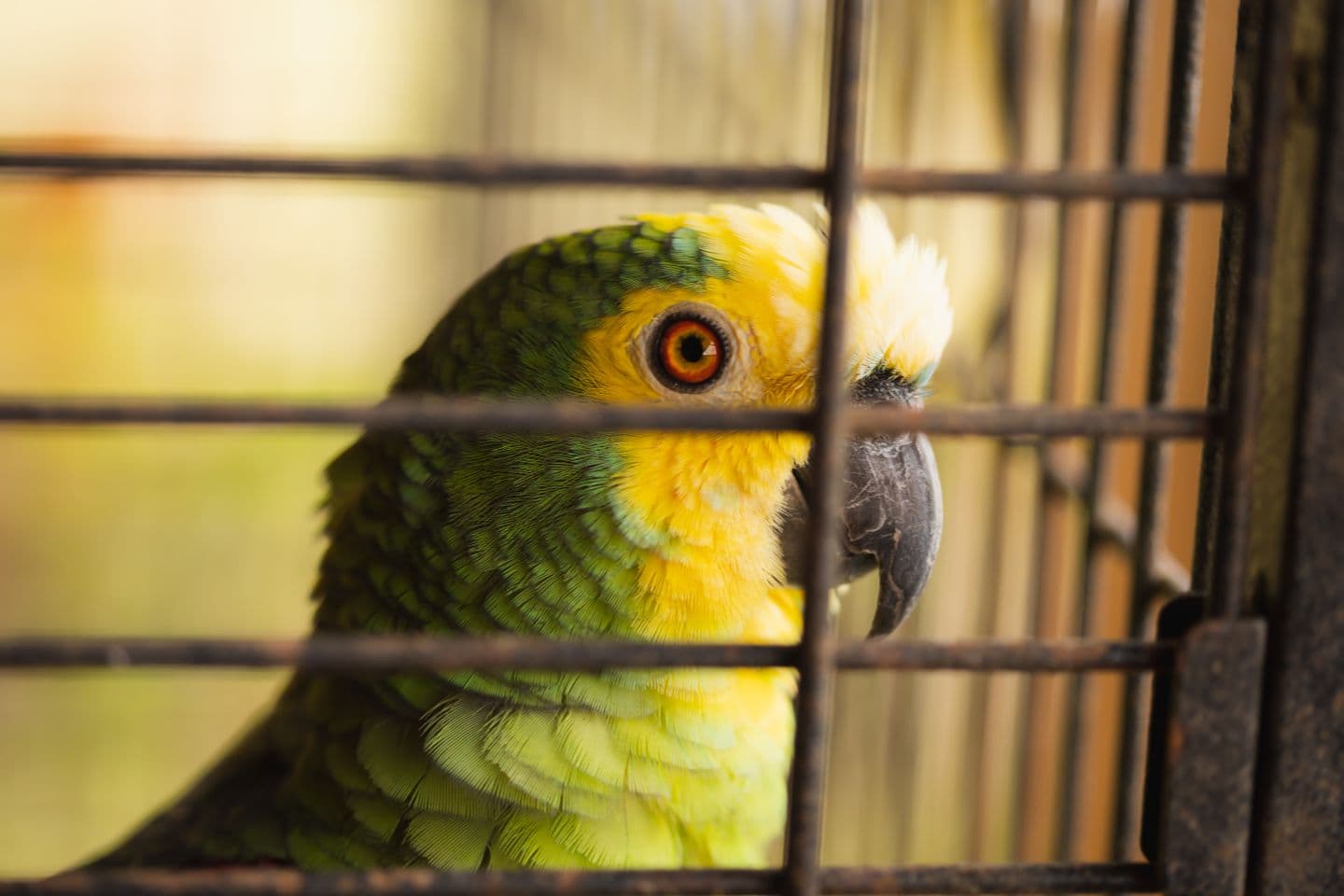
A bird in a small cage is a familiar sight in many households. A colourful budgerigar, a pair of finches or a talking parrot may be considered an attractive addition to a home. The cage is often treated as the bird's entire living environment, with little consideration given to what that means for an animal whose natural life involves flying, exploring, socialising and searching for food. The problem is not simply the size of the cage. It is the restriction of the bird's ability to express natural behaviour.
For most bird species, flight is fundamental to survival and physical well-being. In their natural environments, birds fly to find food, escape predators, explore territories and interact with other birds. Long-term confinement in a small cage can contribute to poor physical conditioning, obesity, reduced exercise capacity, feather damage, repetitive or abnormal behaviours, boredom and frustration. A bird that cannot spread its wings comfortably or move freely between perches is living in an unsuitable environment.
Bird owners should understand the difference between a temporary enclosure and a permanent living environment. An appropriate enclosure should provide sufficient space for the bird to move, stretch, flap its wings and exercise. Where possible, a spacious, secure flight aviary is preferable.
Simply buying a taller cage does not necessarily solve the problem. Many birds need horizontal space to move and fly.
Birds are intelligent animals that need mental stimulation. In nature, much of their day is spent searching for food, interacting with other birds and exploring their surroundings. Captive environments should provide similar opportunities.
Enrichment should be appropriate to the species and individual bird.
Many bird species are naturally social, although their social requirements differ. Some thrive in compatible pairs or groups, while others require carefully managed individual arrangements. Owners must research the natural social behaviour of their particular species. Parrots, for example, can have demanding social and intellectual requirements that are often underestimated when purchased as young birds.
Where indoor flight is possible, the area must be made safe. Windows, ceiling fans, electrical wires, open doors, kitchens and toxic household substances can pose serious risks. Birds should also have access to quiet resting spaces and a predictable daily routine.
A bird should not spend its life looking through bars at the world it was born to explore. The measure of responsible bird ownership is not how beautiful the bird looks in its cage, but how well its environment supports its physical and psychological needs.
Article content © S Vejay Anand. All rights reserved.
Birds / Getting Started
It is possible in many Indian households, but it takes real management, not just hoping for the best.
3 min read
Birds / Health
From paratyphoid to a lung condition now worrying doctors in Mumbai and Delhi, here is what every pigeon keeper and balcony feeder in India should know.
4 min read
Birds / Getting Started
Almost every Indian home has a money plant trailing along a shelf or a tulsi pot on the balcony. Most owners never think twice about it until their bird takes an interested peck, so it is worth knowin
3 min read